
Voyage AI
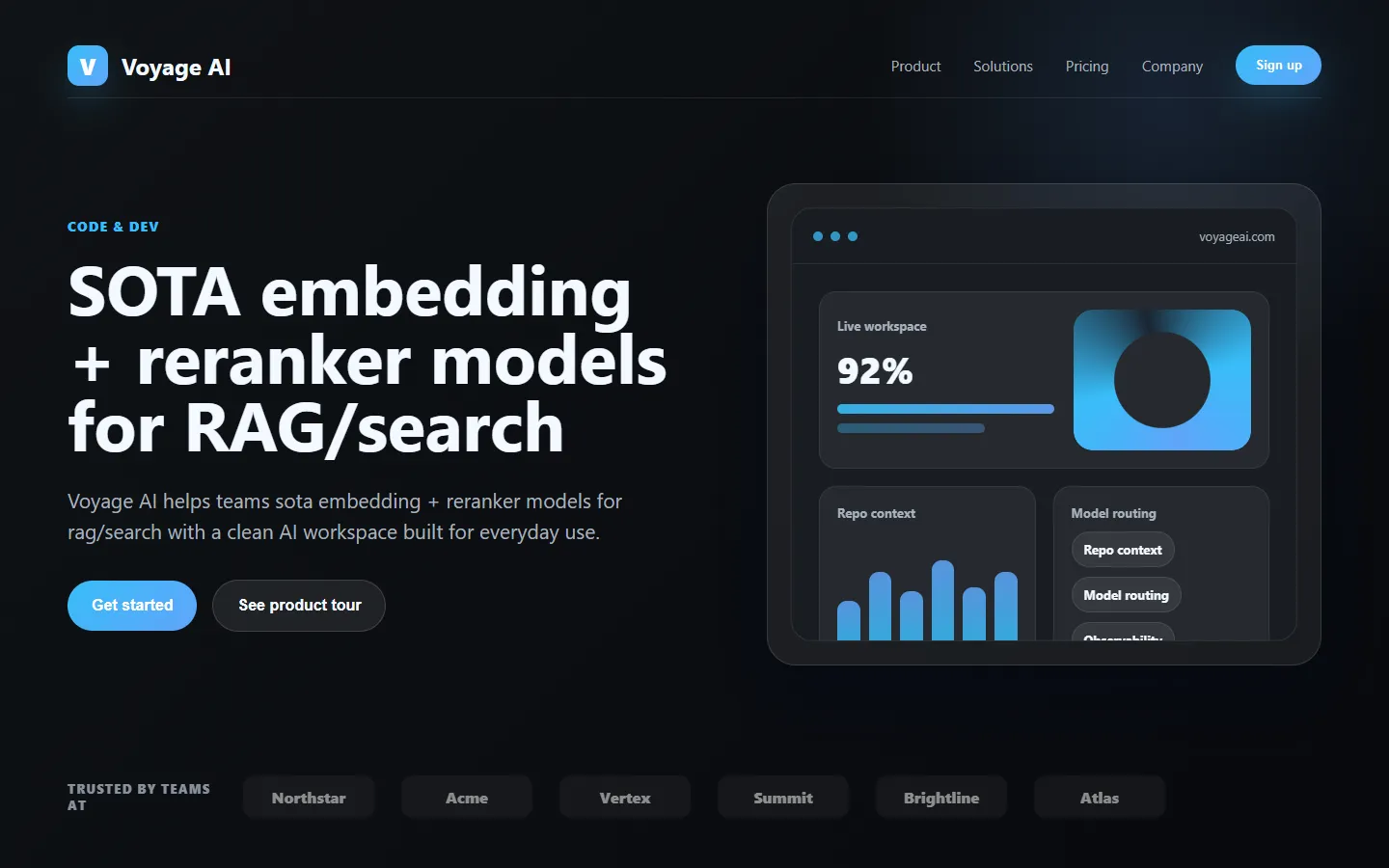
Freemium ✓ Verified 🔥 TrendingVoyage AI builds state-of-the-art embedding and reranker models for retrieval-augmented generation, search, and LLM applications.
📋 About Voyage AI
Voyage AI develops a family of high-quality embedding, reranker, and multimodal models specifically tuned for retrieval-augmented generation and enterprise search. The voyage ai platform is used by AI engineers to convert text, code, and multimodal content into dense vector representations that power semantic search, RAG pipelines, and recommendation systems. Voyage's models consistently rank at or near the top of public retrieval benchmarks, often outperforming general-purpose embedding APIs from larger foundation model providers.
The product set includes general-purpose embeddings, domain-specialized models for code, finance, legal, and healthcare, plus rerankers that reorder initial retrieval results for higher-precision final answers. Voyage also ships multimodal embeddings that handle text and images in a shared vector space, enabling hybrid search over PDFs, slide decks, and product catalogs. Developers integrate the voyage ai embeddings API in a few lines of code, and the service pairs cleanly with vector databases like Pinecone, Weaviate, Chroma, and MongoDB Atlas.
Voyage AI targets developers, AI platform teams, and enterprises building LLM-powered search, chat, and agent applications that need retrieval accuracy well above what generic embeddings deliver. Customers use it to improve RAG answer quality, cut hallucinations, reduce retrieval latency, and lower token usage by keeping context windows focused. Voyage AI was acquired by MongoDB in 2025, which has deepened its integration with Atlas Vector Search while keeping the API available as a standalone service for any stack.
⚡ Key Features of Voyage AI
State-of-the-Art General Embeddings
The voyage ai embeddings models deliver top-tier performance on public retrieval benchmarks like MTEB, consistently outperforming comparable models from OpenAI and Cohere on many tasks. Embeddings are available in multiple dimensions and precision options, letting teams tune quality against storage and latency. Models are kept frozen after release so production systems do not silently change behavior. This predictability is important for regulated and enterprise workloads.
Domain-Specialized Models
Voyage ships embeddings tuned for code, finance, legal, and healthcare content, outperforming general-purpose models on those vertical corpora. Domain models are trained on curated domain data and evaluated on retrieval tasks that mirror real enterprise use cases. Teams building industry-specific RAG see concrete accuracy gains without changing their application architecture. This specialization is a major differentiator compared to one-size-fits-all embedding APIs.
Rerankers for High-Precision Retrieval
Voyage rerankers take an initial set of retrieved candidates and reorder them with deeper context awareness, significantly improving top-k precision for RAG. This two-stage pattern — fast bi-encoder retrieval, followed by a cross-encoder reranker — is the current best practice for high-quality LLM search. Rerankers are exposed through the same API as embeddings, making integration trivial. The resulting answer quality improvements often dwarf the cost of the rerank step.
Multimodal Embeddings for Text and Images
Multimodal models embed text and images into a shared vector space, enabling hybrid search across PDFs, slide decks, product catalogs, and screenshots. This is particularly useful for enterprise document sets where pages mix text, charts, and figures. Queries can be text that retrieves images, or vice versa, without bespoke pipelines. The voyage ai multimodal API abstracts away the complexity of joint embedding training.
Long-Context Document Embeddings
Voyage models accept long input contexts so entire documents or large chunks can be embedded without aggressive splitting. Longer chunks preserve more semantic structure, which improves retrieval quality on documents with complex cross-references. This reduces the classic RAG trap of chopping a document into fragments that lose their meaning. Teams can tune chunk size based on quality, latency, and storage tradeoffs.
Vector Database and MongoDB Atlas Integrations
Voyage AI integrates natively with popular vector databases including MongoDB Atlas Vector Search, Pinecone, Weaviate, and Chroma. With the MongoDB acquisition, the voyage ai models are deeply embedded in Atlas workflows, but the HTTP API continues to work with any stack. This flexibility lets teams adopt Voyage without committing to a specific data layer. Reference architectures and example code shorten time-to-value significantly.
Simple, Predictable Pricing and Free Tier
Voyage offers a generous free tier for embedding tokens per month, making it easy to prototype before committing budget. Paid pricing is per-million-tokens with transparent per-model rates and no surprise tiering. Enterprise contracts add SLAs, private deployment options, and volume discounts. The pricing model fits RAG workloads well because it scales with actual retrieval usage rather than seat counts.
🎯 Use Cases for Voyage AI
⚖️ Voyage AI Pros & Cons
Advantages
- ✓Top-tier retrieval quality on public benchmarks
- ✓Domain-specialized models for code, finance, legal, and healthcare
- ✓Strong rerankers and multimodal embeddings in one unified API
- ✓Deep integration with MongoDB Atlas Vector Search and popular vector DBs
- ✓Transparent pricing with a free tier suitable for prototyping
Drawbacks
- ✗Primarily a developer API with no general-purpose end-user product
- ✗Free tier alone is not enough for production-scale corpora
- ✗Requires familiarity with vector search and RAG patterns to use well
- ✗Fewer language-specific models than some larger providers
📖 How to Use Voyage AI
Sign up at voyageai.com and create an API key from the developer dashboard.
Install the official voyageai Python or JavaScript client, or call the REST API directly.
Pick the right embedding model for your content type — general, code, finance, legal, or multimodal.
Generate embeddings for your document corpus and store them in a vector database such as MongoDB Atlas, Pinecone, Weaviate, or Chroma.
At query time, embed the user query, run nearest-neighbor search, and optionally apply the voyage ai reranker to the top candidates.
Feed the retrieved context into your LLM prompt and iterate on chunking, model choice, and top-k values to tune quality.
❓ Voyage AI FAQ
Voyage AI is used to generate embeddings and rerank retrieval results for RAG, semantic search, recommendations, and other LLM applications. Developers integrate the voyage ai API with vector databases to build high-accuracy retrieval pipelines.
Voyage AI offers a free tier with a monthly token allowance that is enough for prototyping and small projects. Larger workloads use pay-as-you-go pricing by model, with enterprise contracts available for high-volume or regulated deployments.
Voyage AI embeddings typically perform at or near the top of public retrieval benchmarks and often outperform OpenAI embeddings on domain-specific retrieval tasks. Voyage also ships specialized models for code, finance, legal, and healthcare that do not have direct OpenAI equivalents.
Yes. After MongoDB acquired Voyage AI in 2025, the embeddings and rerankers integrate natively with Atlas Vector Search. The standalone API remains available for non-MongoDB stacks, so existing vector database workflows continue to work.
Yes. Voyage provides multimodal embedding models that place text and images in a shared vector space. This enables cross-modal retrieval use cases like searching slide decks, PDFs with charts, and product catalogs with a single query.
Related to Voyage AI

Accrete AI
Accrete AI builds autonomous enterprise AI agents for defense, government, and commercial intelligence workflows.

Ace AI
Ace AI is an AI-powered interview and career coach that helps job seekers prepare with mock interviews, resume feedback, and personalized career guidance.

Actively AI
Actively AI is an AI sales prospecting platform that researches accounts, identifies buyer signals, and writes personalized outbound at pipeline scale.

Airship AI
Airship AI provides video intelligence and data management solutions that use AI to search, analyze, and secure large-scale video evidence.

Alex AI
Alex AI is a macOS AI assistant that lives in your menu bar, offering instant writing help, code assistance, and context-aware productivity features.
Altana AI
Altana AI is a global supply chain intelligence platform that maps the world's supply networks and surfaces risks with AI and public data.
Featured on WhatIf.ai
Add this badge to your website to show you're listed on WhatIf AI
Alternatives to Voyage AI

Base44 AI
Base44 AI is an AI app builder and website builder that generates full-stack web applications from natural language descriptions with backend, database, and UI included.

Browse AI
Browse AI is a no-code web scraping and monitoring tool that extracts structured data from any website and tracks changes over time without writing code.


Cantina AI
Cantina AI is a freemium platform for building and deploying full-stack web applications using AI-assisted development with live preview and one-click deployment.


Chalkie AI
Chalkie AI creates lesson plans, worksheets, quizzes, and differentiated materials mapped to curriculum standards for teachers and tutors.