
Lighthouse AI
Paid ✓ VerifiedLighthouse AI is an intelligent home security system that uses computer vision to recognize people, pets, and events in real time.
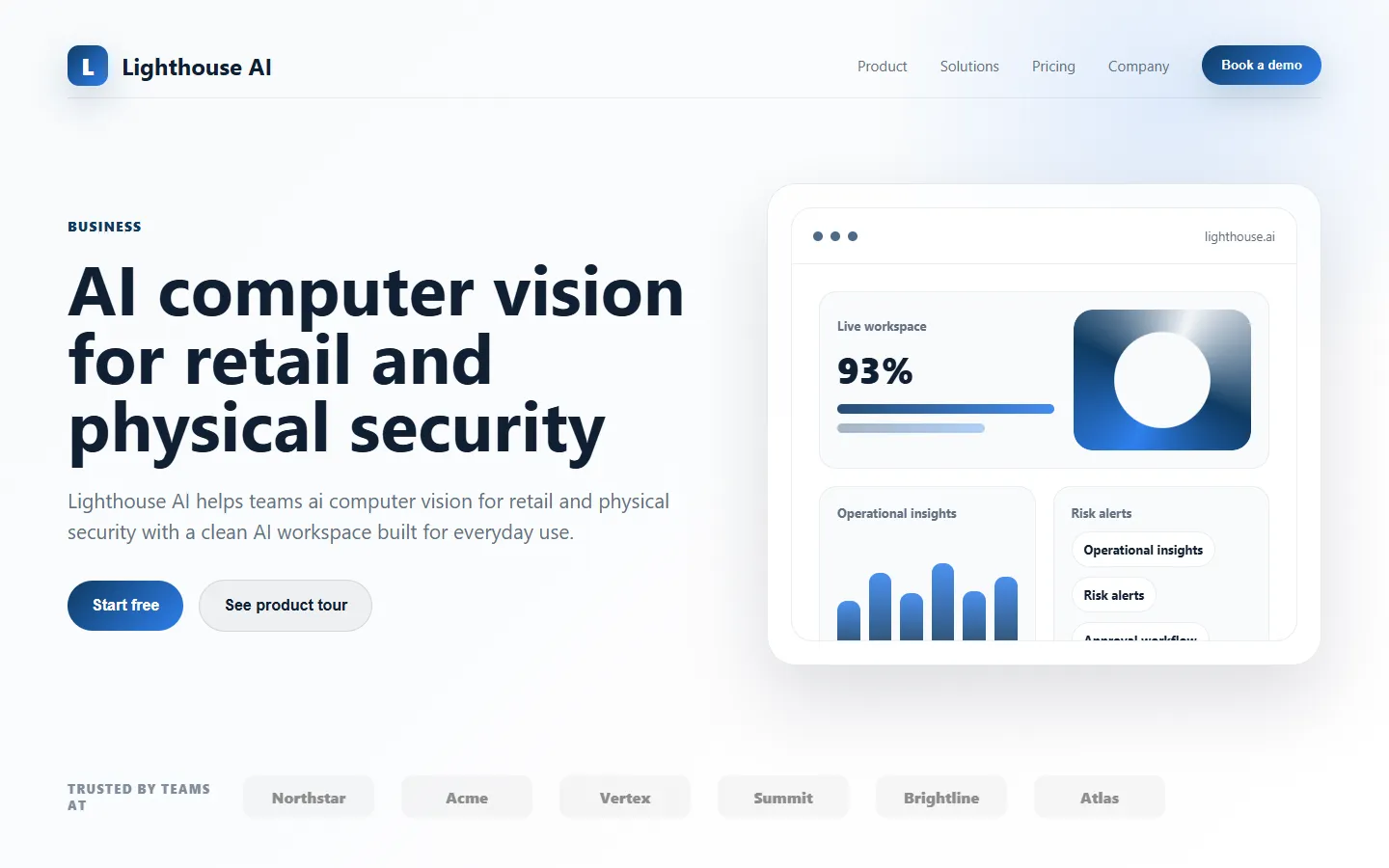
📋 About Lighthouse AI
Lighthouse AI is an intelligent home security camera and monitoring system that uses computer vision to recognize people, pets, and meaningful events rather than flood users with motion alerts for every passing shadow. The lighthouse ai platform identifies who is in frame — family members, familiar visitors, delivery drivers, or unknown individuals — and sends context-rich notifications that distinguish "your daughter arrived home" from "an unknown person is at the door." This dramatically reduces alert fatigue compared to traditional motion-based cameras.
The system supports natural-language interactions. Users can ask "did anyone come by while I was out?" or "show me when the kids got home yesterday" and receive spoken or written answers with relevant video clips. This conversational layer turns hours of recorded footage into instantly queryable memory without manual scrubbing. Smart home integrations trigger actions based on recognition events — turning on lights when a family member arrives, or silencing notifications during family dinner.
Lighthouse AI targets homeowners and renters who want genuine peace of mind rather than a constant stream of false alarms. By combining edge-based processing for privacy with cloud intelligence for advanced queries, it balances protection with personal data stewardship. The product appeals particularly to busy families, frequent travelers, and anyone who has grown frustrated with the alert overload of first-generation smart cameras.
⚡ Key Features of Lighthouse AI
Person and Pet Recognition
Lighthouse ai distinguishes between family members, familiar visitors, strangers, and pets so alerts describe what actually happened rather than generic motion. Users train the system by tagging faces once and the platform improves recognition accuracy over time. This feature alone eliminates the alert fatigue that plagues first-generation motion-based cameras. Pets are identified separately so late-night movement does not trigger false intruder alarms.
Natural-Language Queries
Ask questions like "did anyone come by today?" or "show me when the package was delivered" and receive spoken or written answers with relevant video clips. The query engine indexes every recognized event so retrieval is near-instant rather than requiring manual footage scrubbing. This turns hours of recorded video into a searchable memory. The natural-language interface makes the camera useful for everyday questions rather than only emergency review.
Contextual Smart Notifications
Instead of generic motion alerts, lighthouse ai sends context-rich notifications that describe who did what — "Sarah arrived home at 3:15pm" or "an unknown person is at the front door." Users configure notification priority per recognized person so family members generate quiet updates while unknown visitors trigger higher-priority alerts. Quiet hours mute routine activity so only genuine exceptions interrupt the user. This nuanced alerting respects attention in a way that rule-based systems cannot match.
Smart Home Integration
Trigger smart home actions based on recognition events — turn on the porch light when a family member approaches, disable the security system when the homeowner returns, or play a welcome audio cue. Integrations with popular smart home platforms let lighthouse ai serve as a perception layer for the broader connected home. Automations are configured through simple if-this-then-that style rules. The result is a home that responds to people rather than requiring manual controls.
Edge Processing for Privacy
Video analysis happens primarily on the camera device itself rather than in the cloud, meaning raw footage is not constantly streamed off-site. Only metadata and summary events leave the home unless the user explicitly requests a clip. This architecture addresses the privacy concerns that stop many households from adopting networked cameras. Sensitive recognition data stays under household control.
Event Timeline and Clip Library
Every recognized event is automatically saved as a tagged clip with date, time, people involved, and event type, building a searchable timeline of household activity. Users can review, share, or download specific clips on demand rather than scrubbing through continuous recording. The timeline view makes it easy to reconstruct events after the fact. Clips can be exported for insurance or incident documentation when needed.
🎯 Use Cases for Lighthouse AI
⚖️ Lighthouse AI Pros & Cons
Advantages
- ✓Recognition-based alerts eliminate motion-alert fatigue
- ✓Natural-language queries make footage instantly searchable
- ✓Edge processing protects household privacy
- ✓Strong smart home integrations for automation
- ✓Event timeline creates a useful household activity record
Drawbacks
- ✗Hardware and subscription costs higher than basic cameras
- ✗Recognition accuracy depends on initial training effort
- ✗Advanced features require a paid subscription tier
- ✗Not designed for large commercial security applications
📖 How to Use Lighthouse AI
Purchase a lighthouse ai camera from the official store and install it at your chosen location.
Pair the camera with your home network using the mobile app setup flow.
Train recognition by tagging family members, frequent visitors, and pets in captured clips.
Configure notification priorities and quiet hours in the app settings.
Connect your smart home platform to enable automations triggered by recognition events.
Use natural-language queries in the app to ask about specific events or recent activity.
❓ Lighthouse AI FAQ
Yes. Lighthouse ai uses a hardware-plus-subscription model, with monthly or annual plans that unlock advanced recognition, cloud backup of clips, and natural-language queries.
Primary video analysis happens on the camera itself, so raw footage is not constantly streamed to the cloud. Only metadata and summary events leave the home unless you explicitly request a clip.
Yes. The system lets you tag family members and frequent visitors so notifications describe who is on camera. Accuracy improves as the system sees each person more often.
Yes. Lighthouse AI integrates with popular smart home platforms and can trigger automations based on recognition events, such as turning on lights when a family member arrives.
Edge-based processing means core recognition and recording continue during internet outages. Cloud features like natural-language queries and remote viewing resume when connectivity returns.
Related to Lighthouse AI

15.ai
15.ai is a free AI voice cloning tool famous for generating realistic speech from cartoon, video game, and animated show characters using as little as 15 seconds of source audio.

A2E AI
A2E AI productivity platform converts audio and video recordings into transcripts, summaries, and action items with speaker identification.

Abby AI
Abby AI is an AI therapy and mental wellness chatbot that offers CBT-informed conversations, mood tracking, and self-guided coping tools.

Abnormal AI
Abnormal AI uses behavioral AI to detect business email compromise, account takeover, and socially engineered phishing that bypasses secure email gateways.

LiveReach AI
LiveReach AI is a computer-vision platform that turns retail and venue camera feeds into foot traffic, conversion, and occupancy analytics.

Nami AI
Nami AI is a conversational AI assistant for personal productivity, combining scheduling, notes, tasks, and research in one chat interface.
Featured on WhatIf.ai
Add this badge to your website to show you're listed on WhatIf AI
Alternatives to Lighthouse AI
A2E AI
A2E AI productivity platform converts audio and video recordings into transcripts, summaries, and action items with speaker identification.

Abnormal AI
Abnormal AI uses behavioral AI to detect business email compromise, account takeover, and socially engineered phishing that bypasses secure email gateways.

Abridge AI
Abridge AI medical documentation platform that records and summarizes clinical conversations into structured physician notes in real time.

Air AI
Air AI conducts autonomous full-length AI phone calls for sales prospecting, appointment setting, and customer service without human agents.