
H2O AI
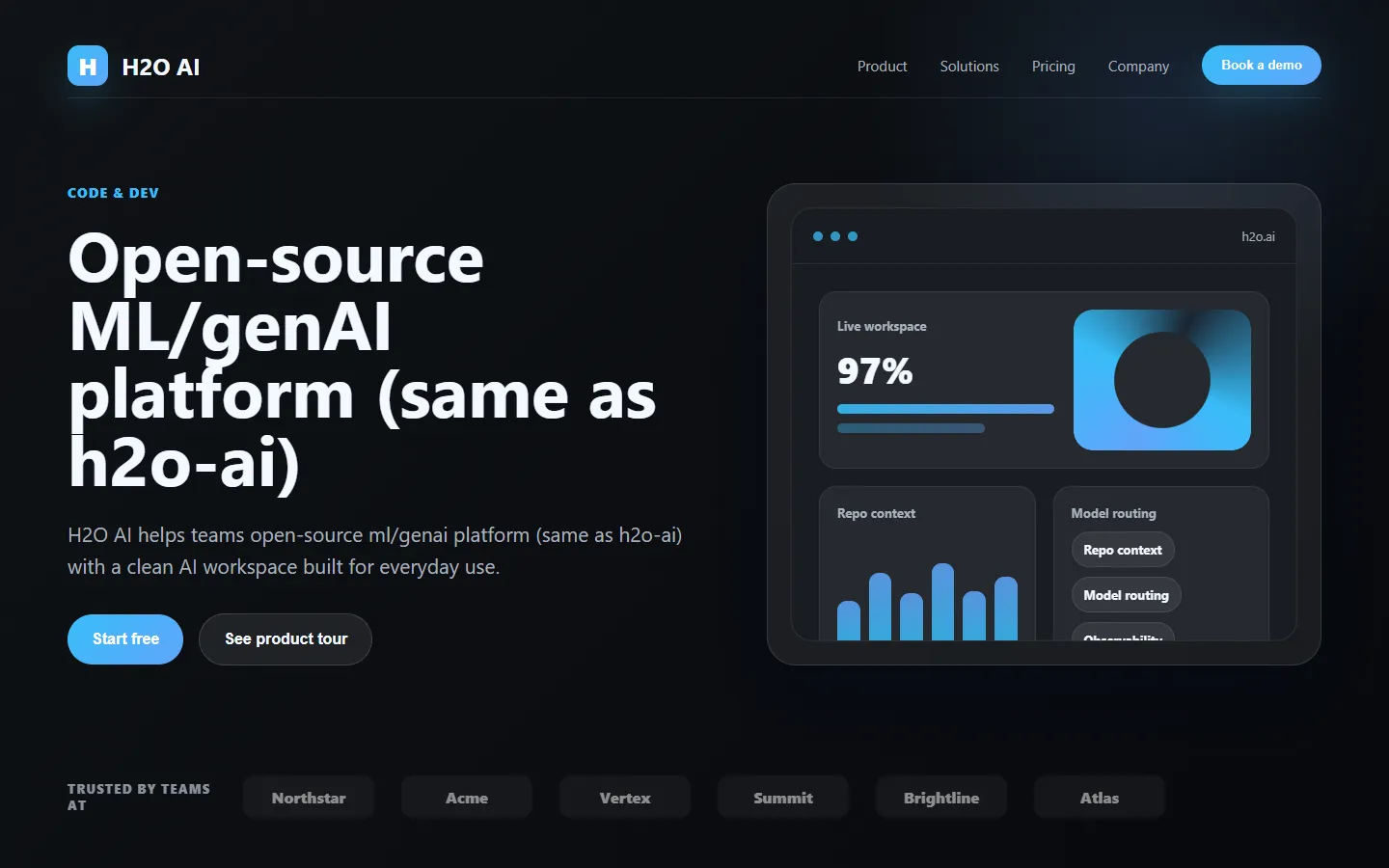
Freemium ✓ Verified 🔥 TrendingH2O AI is an open-source machine learning and generative AI platform for building, deploying, and governing enterprise AI applications.
📋 About H2O AI
H2O AI is a full-stack machine learning and generative AI platform that supports the entire lifecycle of enterprise AI — from data preparation and model training to deployment, monitoring, and governance. The h20 ai platform is best known for its open-source H2O-3 machine learning library, widely used by Fortune 500 data science teams, and its Driverless AI product, which automates feature engineering and model selection for tabular data. More recently, H2O AI has expanded aggressively into generative AI with offerings for fine-tuning open-source large language models, deploying private LLMs, and building retrieval-augmented chatbots grounded in enterprise data.
Enterprises adopt h20 ai for three primary reasons: regulatory defensibility, on-premise control, and cost efficiency. Regulatory defensibility comes from the platform's explainability tools, model documentation, and audit trails that meet requirements in banking, insurance, and healthcare. On-premise control lets organizations run generative AI against private data without sending content to third-party APIs. Cost efficiency comes from leveraging open-source models and H2O's optimization layer rather than paying token fees for every inference.
H2O AI targets data science teams and IT leaders at mid-to-large enterprises who need AI capability while meeting strict compliance, privacy, and cost constraints. The platform is more technically involved than consumer AI tools, but the tradeoff is deep control over data, models, and operational economics. Organizations in regulated industries frequently choose h20 ai specifically because it allows AI adoption without surrendering control to external vendors.
⚡ Key Features of H2O AI
Open-Source H2O-3 ML Library
H2O-3 is a widely adopted open-source machine learning library supporting gradient boosting, deep learning, generalized linear models, and many other algorithms optimized for distributed training on large datasets. The library is free to use, runs on commodity hardware or cloud instances, and has become a standard tool in Fortune 500 data science teams. It integrates with Python, R, and Java, making it accessible to diverse engineering cultures. The open-source foundation builds trust with enterprises wary of black-box vendor lock-in.
Driverless AI for Automated ML
Driverless AI automates feature engineering, model selection, and hyperparameter tuning for tabular data, turning weeks of data-science work into hours. The platform generates explainable models with documentation suitable for regulatory review, which is essential for banks, insurers, and healthcare organizations. Users upload data, specify a target, and receive a production-ready model with reason codes for every prediction. This dramatically shortens the time from problem to deployed solution.
H2O LLM Studio for Fine-Tuning
H2O LLM Studio provides a no-code interface for fine-tuning open-source large language models on proprietary data, running on GPUs the organization already owns or rents. Teams can adapt base models for domain-specific tasks without sharing data with third-party API providers. The studio supports popular open models and training techniques including LoRA and full fine-tuning. This capability is central to h20 ai's private LLM strategy for regulated enterprises.
Enterprise LLM Deployment
Deploy fine-tuned or off-the-shelf open-source LLMs on-premise or in a private cloud, with APIs that integrate into existing applications. H2O AI provides optimization to reduce inference cost and latency, along with governance tools to monitor usage, accuracy, and policy compliance. This lets organizations adopt generative AI without sending sensitive data to external APIs. Cost per query is dramatically lower than commercial API pricing at scale.
Model Governance and Explainability
Comprehensive governance tools track model lineage, performance, drift, and bias across the organization's AI portfolio, with audit trails that meet regulatory requirements in financial services and healthcare. Explainability modules surface reason codes for individual predictions so risk and compliance teams can review model behavior. This governance layer is often the reason regulated enterprises choose h20 ai over less-documented alternatives. It reduces the friction of getting AI applications through internal review boards.
AutoDoc for Model Documentation
Automatically generate comprehensive model documentation covering data lineage, feature engineering steps, performance metrics, and validation results in a format designed to satisfy regulator and auditor expectations. This removes one of the largest hidden costs of enterprise ML — producing the paperwork needed for approval. AutoDoc output can be customized to match firm templates and regulatory frameworks. Data science teams reclaim significant time previously spent on documentation.
🎯 Use Cases for H2O AI
⚖️ H2O AI Pros & Cons
Advantages
- ✓Open-source foundation reduces vendor lock-in
- ✓Strong regulatory explainability and documentation tools
- ✓Private LLM deployment keeps sensitive data in-house
- ✓Supports entire AI lifecycle from training to governance
- ✓Cost-efficient at enterprise scale compared to commercial APIs
Drawbacks
- ✗Requires data science and ML engineering expertise to use well
- ✗More complex than consumer AI tools
- ✗Enterprise features are paid and pricing depends on scope
- ✗Initial deployment and integration effort is non-trivial
📖 How to Use H2O AI
Visit h2o.ai and explore the open-source H2O-3 library or request a demo of the commercial platform.
Set up an environment — cloud, on-premise, or hybrid — according to data residency requirements.
Upload or connect data sources and use Driverless AI for automated model building on tabular problems.
For generative AI projects, fine-tune open-source LLMs with H2O LLM Studio using proprietary data.
Deploy models through the enterprise deployment tooling with governance and monitoring enabled.
Use AutoDoc and explainability tools to prepare documentation for internal review and regulators.
❓ H2O AI FAQ
The core H2O-3 machine learning library is open source and free to use. Commercial products including Driverless AI, LLM Studio, and enterprise deployment tooling are paid with pricing based on scope and usage.
Yes. On-premise deployment is a core reason enterprises in regulated industries choose h20 ai, since it keeps sensitive data on infrastructure the organization controls.
Yes. The platform includes H2O LLM Studio for fine-tuning open-source large language models and enterprise tooling for deploying private LLMs at scale.
H2O AI emphasizes open-source foundations, on-premise deployment, and regulatory explainability. Cloud ML services offer tighter platform integration but less control over data residency and model lineage.
Banks, insurers, healthcare organizations, retailers, and large enterprises use h20 ai when they need AI capability with strict compliance, privacy, and cost requirements.
Related to H2O AI

Accrete AI
Accrete AI builds autonomous enterprise AI agents for defense, government, and commercial intelligence workflows.

Ace AI
Ace AI is an AI-powered interview and career coach that helps job seekers prepare with mock interviews, resume feedback, and personalized career guidance.

Actively AI
Actively AI is an AI sales prospecting platform that researches accounts, identifies buyer signals, and writes personalized outbound at pipeline scale.

Airship AI
Airship AI provides video intelligence and data management solutions that use AI to search, analyze, and secure large-scale video evidence.

Foundation AI
Foundation AI is an enterprise platform for building, deploying, and governing custom large language model applications with retrieval and tools.

Odin AI
Odin AI is a unified enterprise AI platform combining chatbots, knowledge management, automation, and agent workflows in one secure workspace.
Featured on WhatIf.ai
Add this badge to your website to show you're listed on WhatIf AI
Alternatives to H2O AI

Base44 AI
Base44 AI is an AI app builder and website builder that generates full-stack web applications from natural language descriptions with backend, database, and UI included.

Browse AI
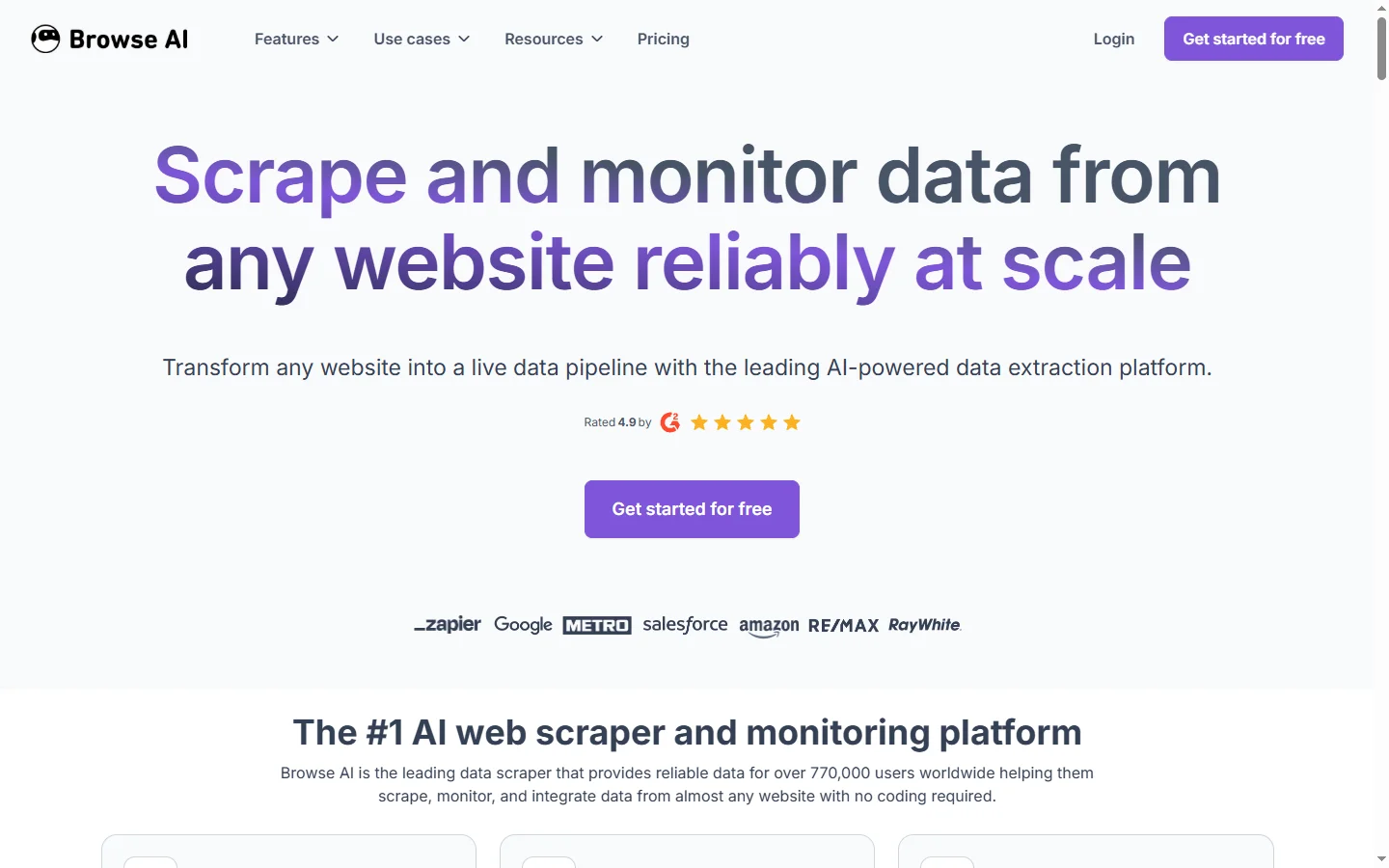
Browse AI is a no-code web scraping and monitoring tool that extracts structured data from any website and tracks changes over time without writing code.


Cantina AI
Cantina AI is a freemium platform for building and deploying full-stack web applications using AI-assisted development with live preview and one-click deployment.


Chalkie AI
Chalkie AI creates lesson plans, worksheets, quizzes, and differentiated materials mapped to curriculum standards for teachers and tutors.