
Cartesia AI
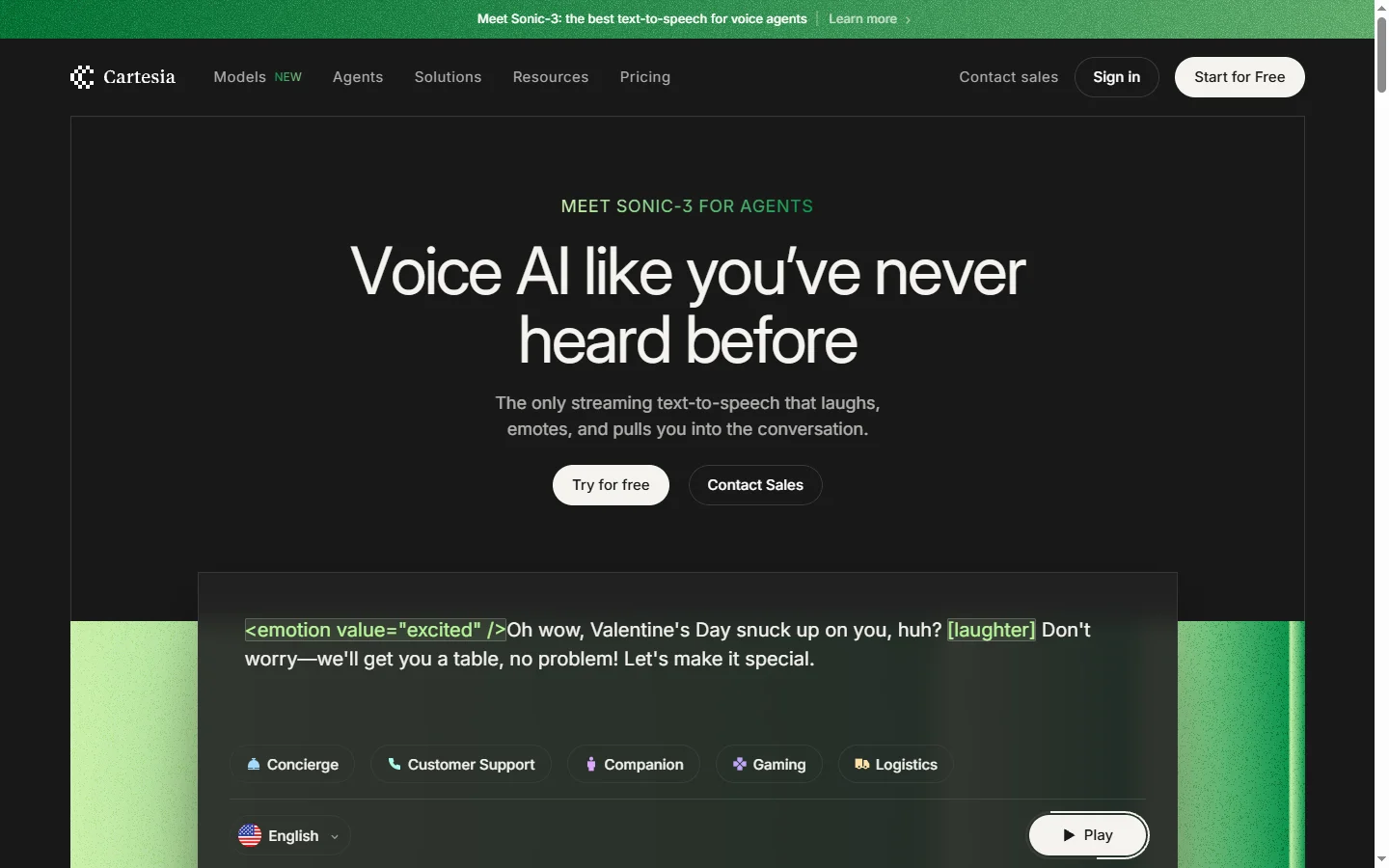
Freemium ✓ Verified 🔥 TrendingCartesia AI is a real-time voice AI platform built on state-space models that delivers ultra-low-latency text-to-speech and voice cloning for conversational applications.
📋 About Cartesia AI
Cartesia AI is a voice AI company that produces some of the fastest and most natural text-to-speech and voice cloning models available, powered by its Sonic family of state-space models. Rather than the transformer architectures that dominate most generative AI, Cartesia's research leans on structured state-space models that deliver lower latency per token — a decisive advantage for real-time conversational applications like phone agents, customer support bots, and interactive voice experiences where delays of a few hundred milliseconds break immersion.
The platform offers TTS and voice cloning through an API that developers can integrate into conversational AI stacks alongside speech-to-text and language model components. Voices stream the first audio chunk within tens of milliseconds of a text token arriving, making it feasible to build AI agents that interrupt naturally, handle overlapping speech, and respond at human conversational cadence. A catalog of pre-built voices in multiple languages and accents covers most production needs, and custom voice cloning is available for branded agent personas with appropriate consent.
Cartesia serves developers building AI phone agents, contact center automation, interactive educational tools, accessibility applications, and voice-first products where latency and naturalness are non-negotiable. The company has raised significant funding from top-tier investors on the strength of its research pedigree and the growing market for real-time voice AI. Its SDKs cover Python, Node.js, and other major ecosystems, with websocket-based streaming as the default interface.
⚡ Key Features of Cartesia AI
Sonic TTS Models
Cartesia's Sonic family generates natural speech with first-chunk latency in the tens of milliseconds, among the fastest in the industry. Voice quality holds up at conversational speeds where many other models either slow down or sound robotic. Models are updated regularly as research advances.
Voice Cloning
Clone voices from short consented audio samples and use them through the standard API. Clones preserve timbre and accent accurately for branded agent personas or localization work. Consent and usage controls help customers maintain responsible deployment.
Streaming API
Audio streams out over websockets as text arrives, so application developers can pipe LLM tokens directly into the voice model without waiting for full responses. This is the mechanism that enables human-cadence conversational AI. SDKs for Python, Node.js, and other major languages wrap the websocket interface.
Multilingual Voice Library
Dozens of pre-built voices across English, Spanish, French, German, Japanese, and other major languages provide production-ready options without custom cloning. Accent and gender diversity within each language helps developers match voices to audience expectations. New voices are added regularly.
Phonemes and SSML Support
Control pronunciation, pauses, emphasis, and prosody through SSML tags and phoneme overrides for edge cases where defaults are wrong. Useful for proper nouns, technical vocabulary, and brand names that TTS models often mispronounce. Handles the last-mile accuracy needs of production deployments.
Low-Latency Infrastructure
Edge-deployed inference minimizes round-trip time between application and model. Latency budgets for conversational agents can be met end-to-end when Cartesia is paired with low-latency ASR and LLM providers. Infrastructure is built specifically for real-time voice workloads.
Developer-Focused Tooling
Playground for testing voices, CLI tools, and detailed documentation make it fast for developers to prototype and ship voice integrations. Transparent pricing based on characters or minutes processed helps teams forecast costs during scale-up. Free tier available for experimentation.
🎯 Use Cases for Cartesia AI
⚖️ Cartesia AI Pros & Cons
Advantages
- ✓Industry-leading first-chunk latency for conversational AI
- ✓State-space model architecture delivers speed without quality loss
- ✓Solid multilingual voice library out of the box
- ✓Streaming websocket API fits naturally into LLM pipelines
- ✓Responsible voice cloning with consent controls
Drawbacks
- ✗Narrower voice variety than older TTS providers like ElevenLabs
- ✗Best results require engineering effort to integrate with other pipeline components
- ✗Enterprise SLAs still maturing compared to large incumbents
📖 How to Use Cartesia AI
Create an account at cartesia.ai and generate an API key in the developer dashboard.
Browse the voice library in the playground and select voices that match your use case.
Integrate the streaming websocket API into your application using the Python, Node.js, or other SDKs.
Pipe tokens from your LLM directly into Cartesia as they arrive to achieve minimum end-to-end latency.
Use SSML tags or phoneme overrides for edge-case pronunciation requirements.
Monitor usage and latency in the dashboard and scale to production as load grows.
❓ Cartesia AI FAQ
Cartesia's Sonic models are built on state-space model architectures that require less compute per token than comparable transformer TTS systems. Combined with edge-deployed inference, this results in first-chunk latency in the tens of milliseconds.
Yes. Cartesia can clone voices from short consented audio samples and serve them through the same streaming API as the pre-built voice library. Consent and usage controls are available for responsible deployment.
Cartesia offers voices across English, Spanish, French, German, Japanese, and several other major languages, with the library expanding over time as new voices are added.
Yes. Cartesia is specifically engineered for real-time use cases like AI phone agents, where sub-second response time is essential. Its streaming API integrates naturally with LLM output.
Yes. Cartesia offers a free tier with monthly character limits so developers can prototype before committing to paid usage.
Related to Cartesia AI

15.ai
15.ai is a free AI voice cloning tool famous for generating realistic speech from cartoon, video game, and animated show characters using as little as 15 seconds of source audio.

Adobe Podcast AI
Adobe Podcast AI enhances spoken audio recordings by removing background noise and improving voice clarity to broadcast-quality standards.

Akuma AI
Akuma AI is an AI music generation platform that creates original songs, instrumentals, and soundtracks from text prompts for creators and indie artists.

Alex AI
Alex AI is a macOS AI assistant that lives in your menu bar, offering instant writing help, code assistance, and context-aware productivity features.

Ambience AI
Ambience AI is an AI medical scribe and clinician platform that automates documentation, coding, and summaries for healthcare providers during patient visits.

Artflow AI
Artflow AI is an end-to-end AI animation platform that turns scripts into narrated animated stories with generated characters, voices, scenes, and lip-synced animation.
Featured on WhatIf.ai
Add this badge to your website to show you're listed on WhatIf AI
Alternatives to Cartesia AI
Adobe Podcast AI
Adobe Podcast AI enhances spoken audio recordings by removing background noise and improving voice clarity to broadcast-quality standards.

Base44 AI
Base44 AI is an AI app builder and website builder that generates full-stack web applications from natural language descriptions with backend, database, and UI included.

Browse AI
Browse AI is a no-code web scraping and monitoring tool that extracts structured data from any website and tracks changes over time without writing code.
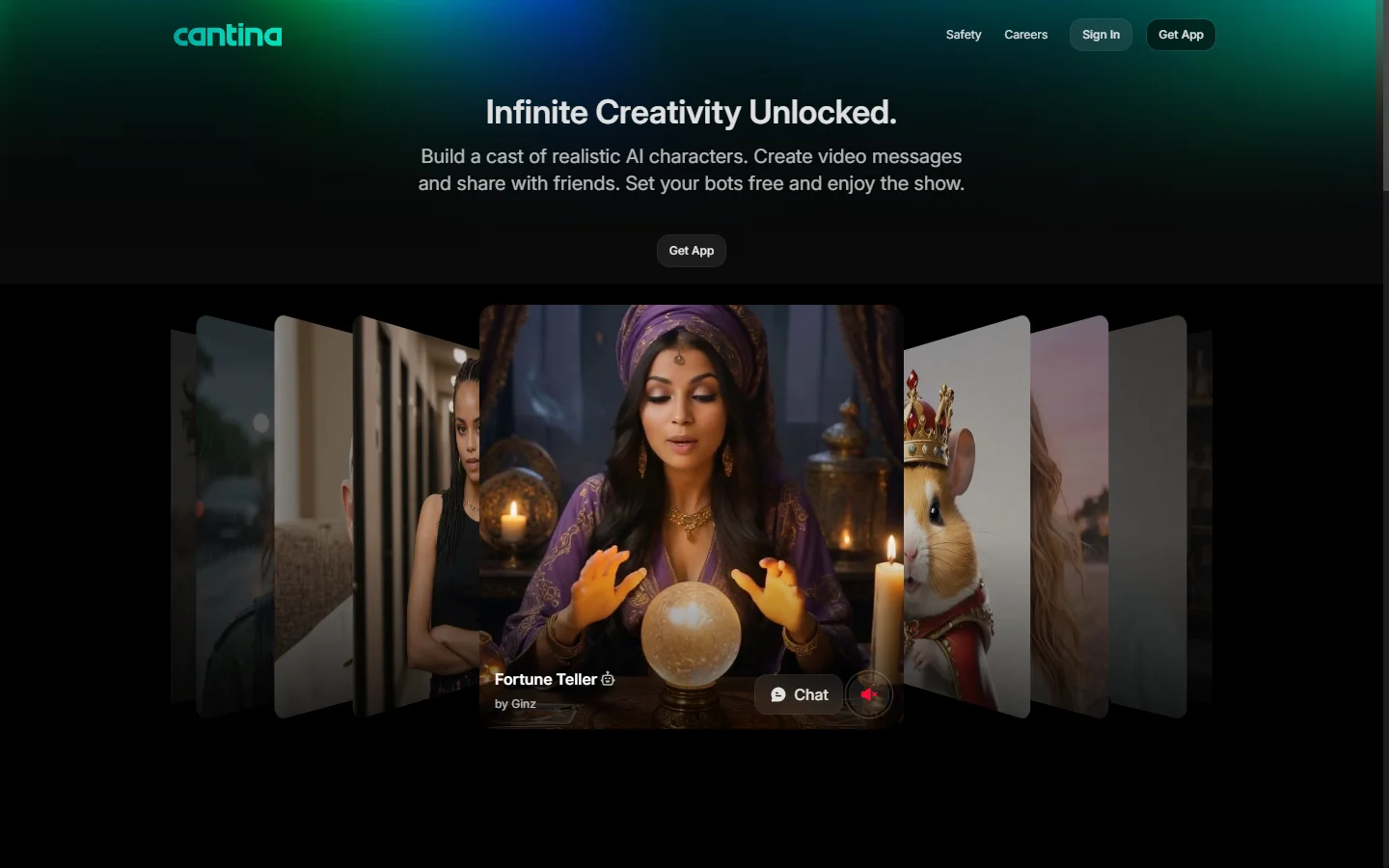

Cantina AI
Cantina AI is a freemium platform for building and deploying full-stack web applications using AI-assisted development with live preview and one-click deployment.