
Artera AI
Paid ✓ VerifiedArtera AI develops multimodal AI biomarkers that personalize cancer treatment by predicting outcomes and therapy response from digital pathology.
📋 About Artera AI
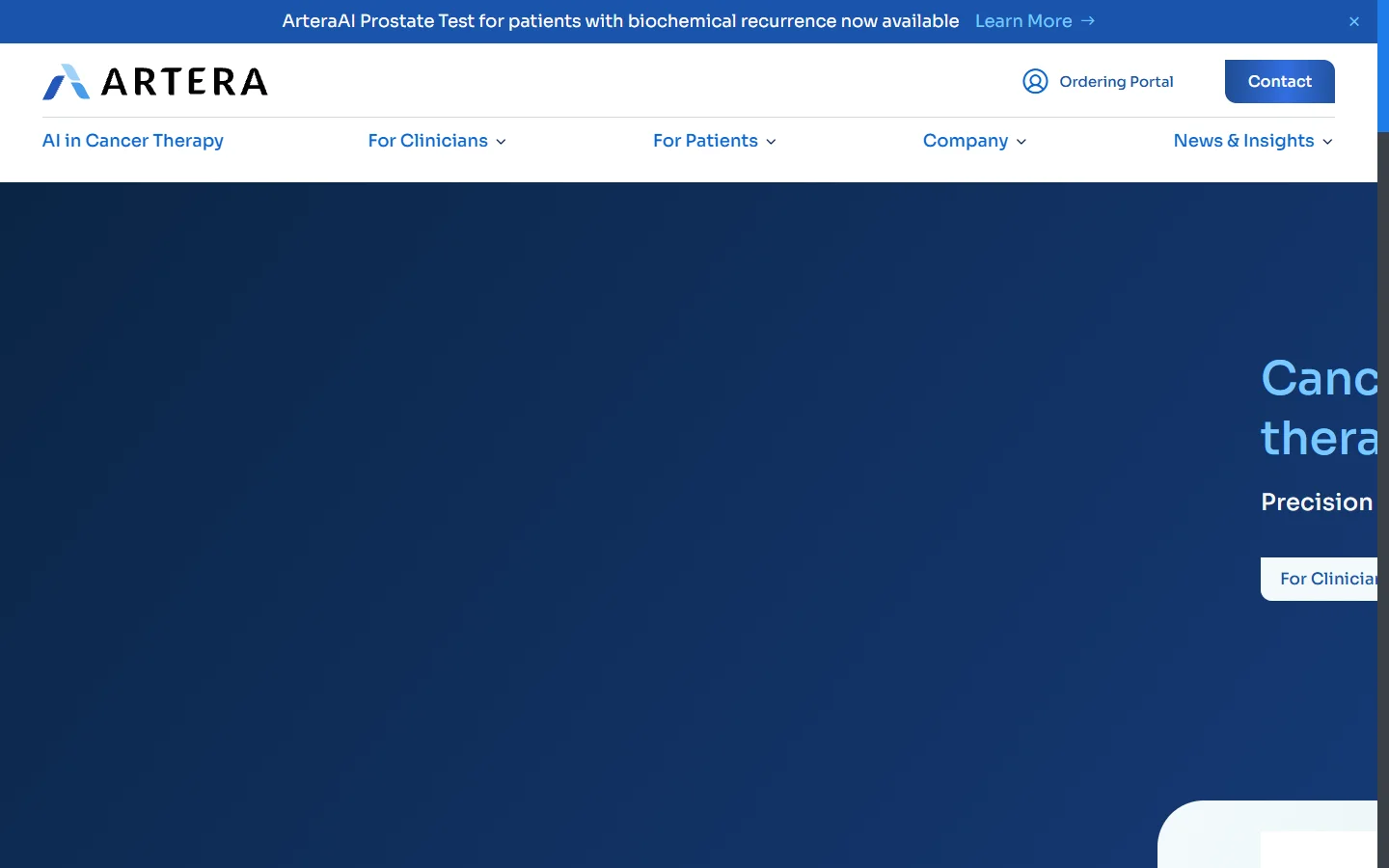
Artera AI is a healthcare AI company that develops multimodal artificial intelligence biomarkers for cancer care, combining digital pathology images with clinical data to predict disease progression, therapy response, and long-term outcomes for individual patients. The flagship artera ai platform — built around the ArteraAI Prostate Test — analyzes standard biopsy slides alongside patient history to stratify prostate cancer patients by risk, guiding decisions about active surveillance, surgery, radiation, and hormone therapy. This shifts treatment planning from average population data to individualized prediction, helping oncologists avoid both overtreatment and undertreatment.
The artera ai platform is clinically validated through multi-site studies using data from landmark NRG Oncology and NCTN trials, giving the biomarkers unusual statistical strength compared to typical AI health products. Oncologists order the test through a standard pathology workflow — scanned slides and clinical data are uploaded, and Artera returns a risk score along with predicted therapy benefit within days. Results integrate into existing treatment planning conversations rather than replacing clinician judgment, positioning artera ai cancer diagnostics as decision support rather than autonomous diagnosis.
Beyond prostate cancer, Artera is expanding the multimodal biomarker approach to additional tumor types and treatment decisions, with an R&D pipeline that includes collaborations with academic medical centers and pharmaceutical companies. The company serves urology and radiation oncology practices, academic cancer centers, and health systems that want to offer personalized oncology decision support without building internal AI capabilities. Reimbursement coverage is advancing as clinical evidence accumulates, making broader deployment practical for community practices as well as large cancer centers.
⚡ Key Features of Artera AI
Multimodal AI Biomarkers
Artera ai combines digital pathology images with structured clinical data — PSA, Gleason score, age, comorbidities — to produce individualized risk and therapy benefit predictions that outperform either modality alone. This multimodal approach captures tissue-level signals that traditional staging misses, giving oncologists additional information for treatment decisions. The ai biomarker output is a calibrated score with confidence bounds rather than a black-box recommendation, supporting shared decision-making. Multiple biomarker outputs can be produced from the same input slides.
ArteraAI Prostate Test
The flagship product predicts long-term outcomes and therapy benefit for prostate cancer patients from standard biopsy slides and clinical inputs, helping oncologists choose between surveillance, surgery, radiation, and hormone therapy. The test is clinically validated in data from NRG Oncology phase III trials, giving it statistical power uncommon in AI health products. Results are returned within days through a pathology workflow compatible with existing laboratory operations. Urologists and radiation oncologists integrate the score into treatment planning discussions with patients.
Clinical Validation at Scale
Artera ai biomarkers are developed and validated using multi-site randomized controlled trial data, producing evidence packages that meet oncology community standards for adoption. Published studies in peer-reviewed journals support the clinical utility claims made to physicians and payors. This evidence base differentiates the artera ai cancer platform from many AI health tools that rely primarily on retrospective single-site cohorts. Ongoing studies extend evidence across demographics, practice settings, and therapy options.
Pathology and EHR Integration
Results flow into existing pathology lab information systems and EHRs, so ordering and result review fit within normal oncology workflows rather than requiring a separate application. Digital pathology scanners from major vendors are supported for slide ingestion. This integration-friendly posture is critical for adoption in community practices where clinicians will not tolerate workflow friction. Secure data handling aligns with HIPAA and applicable international health privacy regulations.
Decision-Support Reporting
Reports are designed to be clinically interpretable, presenting risk scores, predicted therapy benefits, and confidence bounds in a format oncologists and patients can discuss together. This supports shared decision-making rather than positioning the artera ai platform as autonomous diagnosis, which aligns with current oncology norms and regulatory expectations. Plain-language summaries help patients understand their specific predictions. Educational materials support clinician onboarding and patient conversations.
Expanding Biomarker Pipeline
Artera is developing additional biomarkers for other tumor types and treatment decisions — breast, bladder, and additional prostate cancer questions — through collaborations with academic cancer centers and pharmaceutical partners. This expansion brings the multimodal AI approach to more patients and more clinical decisions over time. Pharma collaborations apply the biomarker technology to clinical trial enrichment and companion diagnostic development. The platform architecture is designed to host multiple assays and tumor types on common infrastructure.
Reimbursement and Access Support
Artera works with payors and health systems on coverage, coding, and reimbursement to make the tests accessible in community practice, not just academic centers. Patient access programs help reduce out-of-pocket costs where coverage is limited. This commercial support is as important as the underlying science for real-world clinical impact. Health economics data supports coverage decisions by payors considering precision oncology investment.
🎯 Use Cases for Artera AI
⚖️ Artera AI Pros & Cons
Advantages
- ✓Clinically validated in NRG Oncology phase III trial data
- ✓Multimodal approach outperforms single-modality biomarkers
- ✓Integrates with existing pathology and oncology workflows
- ✓Supports shared decision-making with interpretable reports
- ✓Expanding pipeline beyond prostate cancer to additional tumor types
Drawbacks
- ✗Currently focused primarily on prostate cancer applications
- ✗Requires digital pathology infrastructure and scanned slides
- ✗Reimbursement coverage varies by payor and region
- ✗Clinician adoption requires education and workflow integration
📖 How to Use Artera AI
Visit artera.ai to explore available tests and request information about the ArteraAI Prostate Test or clinical partnerships.
Work with your pathology lab to ensure biopsy slides are digitized using a compatible scanner.
Order the test through your standard pathology workflow, uploading slides and relevant clinical data.
Receive the risk score and therapy benefit report within days, typically through your EHR or pathology information system.
Review the artera ai report with the patient as part of the treatment planning conversation.
For health systems and pharma partners, contact Artera directly for integration, collaboration, or platform licensing discussions.
❓ Artera AI FAQ
No. Artera ai tests are medical diagnostics with pricing set through healthcare reimbursement and self-pay channels. Coverage varies by payor and region; Artera offers patient access programs to reduce out-of-pocket costs where insurance coverage is limited.
The primary commercial product is the ArteraAI Prostate Test for prostate cancer risk stratification and therapy benefit prediction. Additional tumor types and biomarker applications are under active development through R&D collaborations.
Traditional genomic tests analyze DNA or RNA from tissue samples. Artera ai uses multimodal AI combining digital pathology images with clinical data, which captures different tissue-level signals and requires only standard biopsy slides rather than specialized genomic processing.
Artera ai tests are offered through CLIA-certified laboratory pathways with appropriate regulatory oversight for diagnostic tests. Specific regulatory status should be confirmed directly with Artera for the test and jurisdiction of interest.
Tests are ordered by treating physicians — typically urologists, radiation oncologists, or medical oncologists — as part of cancer treatment planning. Patients discuss whether the test is appropriate with their care team rather than ordering directly.
Related to Artera AI

15.ai
15.ai is a free AI voice cloning tool famous for generating realistic speech from cartoon, video game, and animated show characters using as little as 15 seconds of source audio.

Abby AI
Abby AI is an AI therapy and mental wellness chatbot that offers CBT-informed conversations, mood tracking, and self-guided coping tools.

Accrete AI
Accrete AI builds autonomous enterprise AI agents for defense, government, and commercial intelligence workflows.

Ace AI
Ace AI is an AI-powered interview and career coach that helps job seekers prepare with mock interviews, resume feedback, and personalized career guidance.

Paige AI
Paige AI is an FDA-cleared computational pathology platform that uses deep learning to help pathologists diagnose cancer faster and with greater accuracy.
Featured on WhatIf.ai
Add this badge to your website to show you're listed on WhatIf AI
Alternatives to Artera AI


Chalkie AI
Chalkie AI creates lesson plans, worksheets, quizzes, and differentiated materials mapped to curriculum standards for teachers and tutors.

ChatGPT
ChatGPT AI assistant by OpenAI for writing, coding, research, image analysis, and everyday problem-solving.


Cheater Buster AI
Cheater buster ai tool that searches dating apps by name and location to find matching profiles discreetly.

Claude
Claude AI assistant by Anthropic with a 200K context window, strong reasoning, and safety-focused design for writing, coding, and analysis.