
Rain AI
Paid ✓ Verified 🔥 TrendingRain AI develops neuromorphic AI chips that deliver high-performance, energy-efficient AI compute for edge and data center deployment.
📋 About Rain AI
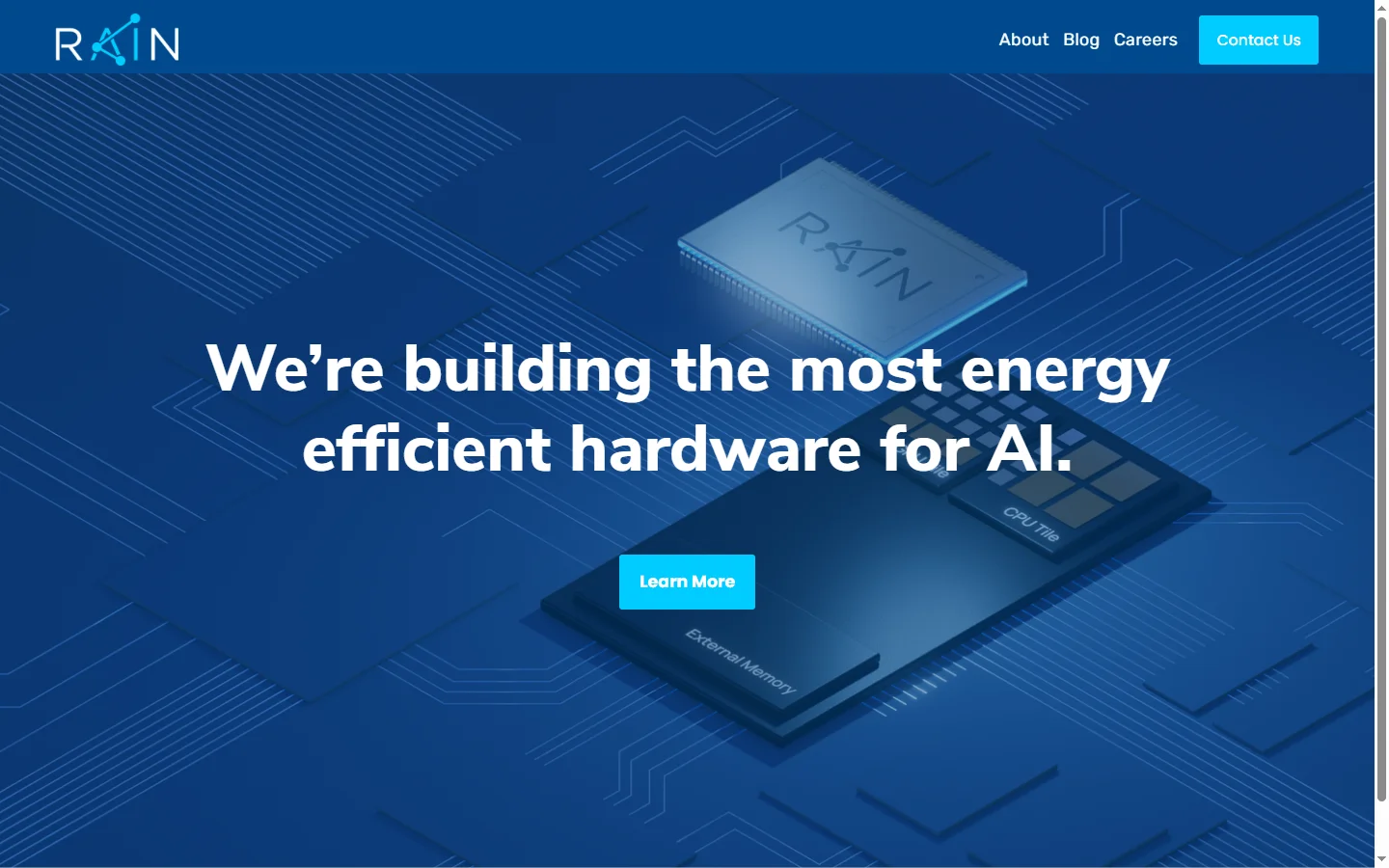
Rain AI is an AI hardware company developing neuromorphic chips inspired by the architecture of the human brain to dramatically improve the energy efficiency and scale of AI workloads. The rain ai platform combines custom silicon, compiler tools, and software libraries targeting large language model training and inference at fractions of the power consumption of conventional GPU-based systems. As AI models grow larger and more pervasive, their energy consumption has become a major constraint on scaling further; Rain aims to solve this through fundamentally different chip architecture rather than incremental GPU improvements.
Neuromorphic design uses analog-in-memory computing and sparse activation patterns that mirror how biological neurons process information, avoiding the energy-intensive data movement that dominates conventional AI chip power budgets. The rain ai processors are designed to run transformer architectures efficiently, making them suitable for LLM inference at data center scale and edge deployment for on-device AI. Rain has attracted significant investor and industry partner interest given the implications for AI economics and sustainability.
Rain AI serves cloud providers, AI product companies, device manufacturers, and research labs seeking alternatives to the compute and energy costs of GPU-based AI. Early customers are typically large organizations with significant AI inference workloads where efficiency gains translate to meaningful cost and sustainability improvements. The company is venture-backed and in active product development and partnership-building phases, with hardware and software tools progressing through customer evaluation programs. Long-term vision includes enabling AI personalization on-device at power levels impossible with current silicon.
⚡ Key Features of Rain AI
Neuromorphic Chip Architecture
Custom silicon uses analog-in-memory computing inspired by biological neurons, dramatically reducing the data movement that dominates conventional chip power consumption. The rain ai design targets order-of-magnitude efficiency gains over GPU-based approaches. This is a fundamentally different path than incremental GPU scaling. Performance per watt is the primary design axis.
LLM-Optimized Inference
Hardware and software stack are designed around transformer architectures common in modern LLMs, enabling efficient inference for models like GPT, Llama, and similar systems. This pragmatic focus addresses the largest and fastest-growing AI workload. The ai hardware platform's software tooling compiles common model architectures directly. Customers can migrate existing models with minimal rework.
Compiler and Software Stack
Custom compilers map popular AI frameworks — PyTorch, JAX, ONNX — onto neuromorphic hardware, abstracting silicon details from application developers. This lowers the learning curve compared to programming novel chips from scratch. Developers can evaluate Rain on existing workloads without overhauling their stack. Software tooling continues to expand model coverage.
Edge Deployment Potential
Energy efficiency makes it feasible to run LLM-class models on power-constrained edge devices — smartphones, wearables, IoT — that cannot host today's GPU-powered inference. The rain ai roadmap includes device-scale product targets. Offline, on-device AI unlocks privacy, latency, and reliability advantages. This is among the most compelling long-term implications of efficient chip design.
Data Center Scalability
At data center scale, efficiency gains translate directly to reduced cooling, power, and operational costs for AI workloads. This matters at hyperscale where power is increasingly the dominant constraint. The ai hardware platform pairs with standard rack infrastructure for manageable deployment. Early customer programs validate throughput and efficiency under realistic workloads.
Sustainability Story
Lower power consumption per inference reduces AI's carbon footprint and water use, aligning with corporate sustainability commitments. Organizations facing pressure on environmental metrics find efficient chips compelling on ESG grounds alone. Rain publishes performance-per-watt benchmarks for customer evaluation. This resonates with responsible AI investment theses.
🎯 Use Cases for Rain AI
⚖️ Rain AI Pros & Cons
Advantages
- ✓Order-of-magnitude energy efficiency potential
- ✓Purpose-built for LLM inference workloads
- ✓Compatible with popular AI frameworks via compiler
- ✓Opens path to on-device AI at smartphone scale
- ✓Strong sustainability and ESG story
Drawbacks
- ✗Early-stage product with limited commercial availability
- ✗Not suitable for general consumer or developer use yet
- ✗Customer onboarding currently partnership-based
- ✗Ecosystem support narrower than established GPU stacks
📖 How to Use Rain AI
Visit rain.ai and learn about the company's products, research, and partnership programs.
Contact Rain's business development team to discuss your AI workload and evaluation goals.
Participate in early customer programs to benchmark rain ai hardware on your specific models.
Use Rain's compiler and software stack to map PyTorch, JAX, or ONNX models onto the chip.
Measure throughput, latency, and energy efficiency against your current GPU-based deployment.
Plan production deployment with Rain's engineering team including integration, support, and scaling.
❓ Rain AI FAQ
Rain AI is a company developing neuromorphic AI chips — custom silicon inspired by the brain's architecture that aims to dramatically improve the energy efficiency of AI inference compared to conventional GPUs.
Rain is in active development and customer evaluation programs rather than broad retail availability. Interested organizations engage through the company's business development team for early partnerships.
Rain targets LLM training and inference — transformer-based models like GPT and Llama — where efficiency gains translate most directly to cost and sustainability improvements.
Rain's neuromorphic architecture aims for order-of-magnitude energy efficiency gains versus conventional GPUs, particularly for LLM inference. Performance comparisons depend on the specific workload and model architecture.
Yes. Long-term, the rain ai roadmap targets device-scale products that would enable LLM-class models to run on smartphones and embedded devices, unlocking offline AI with privacy and latency benefits.
Related to Rain AI

15.ai
15.ai is a free AI voice cloning tool famous for generating realistic speech from cartoon, video game, and animated show characters using as little as 15 seconds of source audio.

Abby AI
Abby AI is an AI therapy and mental wellness chatbot that offers CBT-informed conversations, mood tracking, and self-guided coping tools.

Accrete AI
Accrete AI builds autonomous enterprise AI agents for defense, government, and commercial intelligence workflows.

Ace AI
Ace AI is an AI-powered interview and career coach that helps job seekers prepare with mock interviews, resume feedback, and personalized career guidance.

Actively AI
Actively AI is an AI sales prospecting platform that researches accounts, identifies buyer signals, and writes personalized outbound at pipeline scale.

Claude
Claude AI assistant by Anthropic with a 200K context window, strong reasoning, and safety-focused design for writing, coding, and analysis.
Featured on WhatIf.ai
Add this badge to your website to show you're listed on WhatIf AI
Alternatives to Rain AI

Base44 AI
Base44 AI is an AI app builder and website builder that generates full-stack web applications from natural language descriptions with backend, database, and UI included.


Browse AI
Browse AI is a no-code web scraping and monitoring tool that extracts structured data from any website and tracks changes over time without writing code.


Cantina AI
Cantina AI is a freemium platform for building and deploying full-stack web applications using AI-assisted development with live preview and one-click deployment.

ChatGPT
ChatGPT AI assistant by OpenAI for writing, coding, research, image analysis, and everyday problem-solving.