
Precision AI
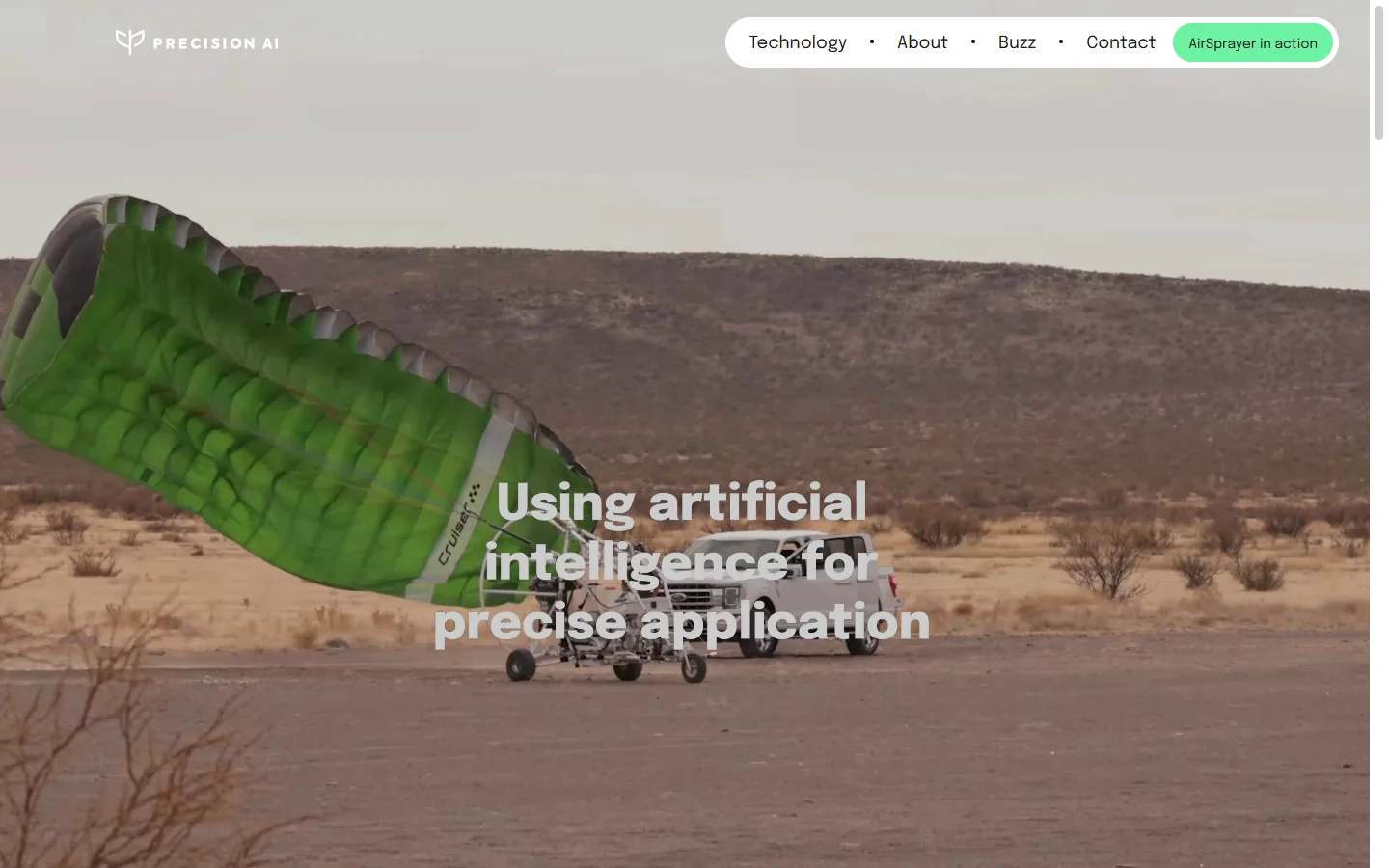
Paid ✓ VerifiedPrecision AI uses computer vision and autonomous drones to detect weeds and precisely spray crops, reducing herbicide use by up to 90% in large-scale farming.
📋 About Precision AI
Precision AI is an agricultural technology company that combines computer vision, autonomous drones, and machine learning to deliver spot-spraying of crops at the individual plant level. Instead of blanket-spraying entire fields with herbicide — the standard practice that wastes chemical inputs and harms soil biology — Precision AI's drones identify weeds in real time as they fly overhead and apply herbicide only where it is needed. Field trials have demonstrated reductions of up to 90% in herbicide use without any loss of weed control efficacy, translating into dramatic cost savings and environmental benefits for large row-crop farms.
The platform combines heavy-lift agricultural drones, proprietary multi-spectral sensors, and onboard AI models trained on millions of labeled crop and weed images. Fleets of drones fly autonomous swaths across large fields, coordinate their coverage, and return to base stations for refilling automatically. Farm operators monitor coverage, weed pressure maps, and chemical usage from a central software dashboard that integrates with popular precision agriculture platforms and farm management systems.
Precision AI is aimed at large-scale row-crop operations in North America, South America, and Australia growing corn, soy, wheat, and canola. The value proposition is both economic — reducing herbicide costs and labor — and environmental, since reduced chemical use improves soil health, protects nearby waterways, and helps farms achieve sustainability certifications increasingly demanded by buyers and regulators. The company is part of a broader wave of agtech startups applying AI to specific crop protection problems.
⚡ Key Features of Precision AI
Real-Time Weed Detection
Onboard computer vision models identify individual weeds versus crop plants as drones fly overhead, distinguishing between species with sufficient accuracy to drive targeted spraying. The models are trained on millions of labeled field images across different crops, growth stages, and lighting conditions, enabling reliable performance across variable field conditions.
Autonomous Drone Fleets
Heavy-lift agricultural drones fly fully autonomous coverage missions across large fields, coordinating their swaths so no area is missed or double-covered. Drones return automatically to base stations for refilling and battery swaps, enabling continuous operation over hundreds of acres per day with minimal human intervention.
Spot Spraying at Plant Level
Each spray nozzle activates individually when the vision system detects a weed directly below, applying herbicide only to the target plant rather than the entire swath. Field trials have demonstrated reductions of up to 90% in chemical usage while maintaining equivalent weed control efficacy compared to traditional broadcast spraying.
Multi-Spectral Sensing
Proprietary sensor arrays capture data beyond visible light, including near-infrared and red-edge bands that help distinguish stressed crops, specific weed species, and subtle growth differences invisible to RGB cameras. This extra signal makes the vision models more robust to natural field variability.
Field Management Dashboard
Farm operators monitor drone fleet status, coverage maps, weed pressure heatmaps, and chemical usage through a central software dashboard. Historical data supports trend analysis across seasons and fields so operations can adjust crop rotations, input plans, and agronomic strategies with precise data.
Precision Agriculture Integration
The platform integrates with established precision agriculture and farm management systems including John Deere Operations Center, Climate FieldView, and AgLeader. This lets farms combine Precision AI's weed detection data with yield maps, soil samples, and planting records for more holistic agronomic decision-making.
🎯 Use Cases for Precision AI
⚖️ Precision AI Pros & Cons
Advantages
- ✓Up to 90% reduction in herbicide usage
- ✓Fully autonomous operation at scale
- ✓Integrates with mainstream precision agriculture platforms
- ✓Strong environmental and sustainability benefits
- ✓Real-time weed pressure mapping supports agronomic decisions
Drawbacks
- ✗High capital cost versus traditional ground sprayers
- ✗Weather-dependent flight operations can delay schedules
- ✗Regulatory rules for agricultural drones vary by region
📖 How to Use Precision AI
Engage Precision AI through precision.ai to discuss your farm size, crops, and goals.
Work with the team to deploy drone base stations and integrate with your farm management system.
Plan field missions using the central dashboard and target problem areas identified by historical data.
Launch autonomous drone fleets, which will fly coverage missions and spot-spray detected weeds.
Monitor real-time coverage, chemical usage, and weed pressure heatmaps during and after missions.
Review seasonal data to refine crop protection strategy, rotations, and input budgets.
❓ Precision AI FAQ
No. Precision AI is sold to farms as a service or capital-equipment deployment. Pricing depends on acreage covered, number of drones, and level of service.
Field trials have demonstrated reductions of up to 90% in herbicide usage compared to conventional broadcast spraying while maintaining equivalent weed control.
Precision AI primarily supports large row crops such as corn, soy, wheat, and canola, though the underlying technology can extend to other crops over time.
Yes. Precision AI integrates with John Deere Operations Center, Climate FieldView, AgLeader, and other major precision agriculture platforms.
Related to Precision AI

15.ai
15.ai is a free AI voice cloning tool famous for generating realistic speech from cartoon, video game, and animated show characters using as little as 15 seconds of source audio.

Abby AI
Abby AI is an AI therapy and mental wellness chatbot that offers CBT-informed conversations, mood tracking, and self-guided coping tools.

Accrete AI
Accrete AI builds autonomous enterprise AI agents for defense, government, and commercial intelligence workflows.

Ace AI
Ace AI is an AI-powered interview and career coach that helps job seekers prepare with mock interviews, resume feedback, and personalized career guidance.
Featured on WhatIf.ai
Add this badge to your website to show you're listed on WhatIf AI
Alternatives to Precision AI


Chalkie AI
Chalkie AI creates lesson plans, worksheets, quizzes, and differentiated materials mapped to curriculum standards for teachers and tutors.

ChatGPT
ChatGPT AI assistant by OpenAI for writing, coding, research, image analysis, and everyday problem-solving.


Cheater Buster AI
Cheater buster ai tool that searches dating apps by name and location to find matching profiles discreetly.

Claude
Claude AI assistant by Anthropic with a 200K context window, strong reasoning, and safety-focused design for writing, coding, and analysis.