
Positron AI
Paid ✓ VerifiedPositron AI builds custom silicon and inference appliances that run large language models faster and cheaper than GPU-based infrastructure.
📋 About Positron AI
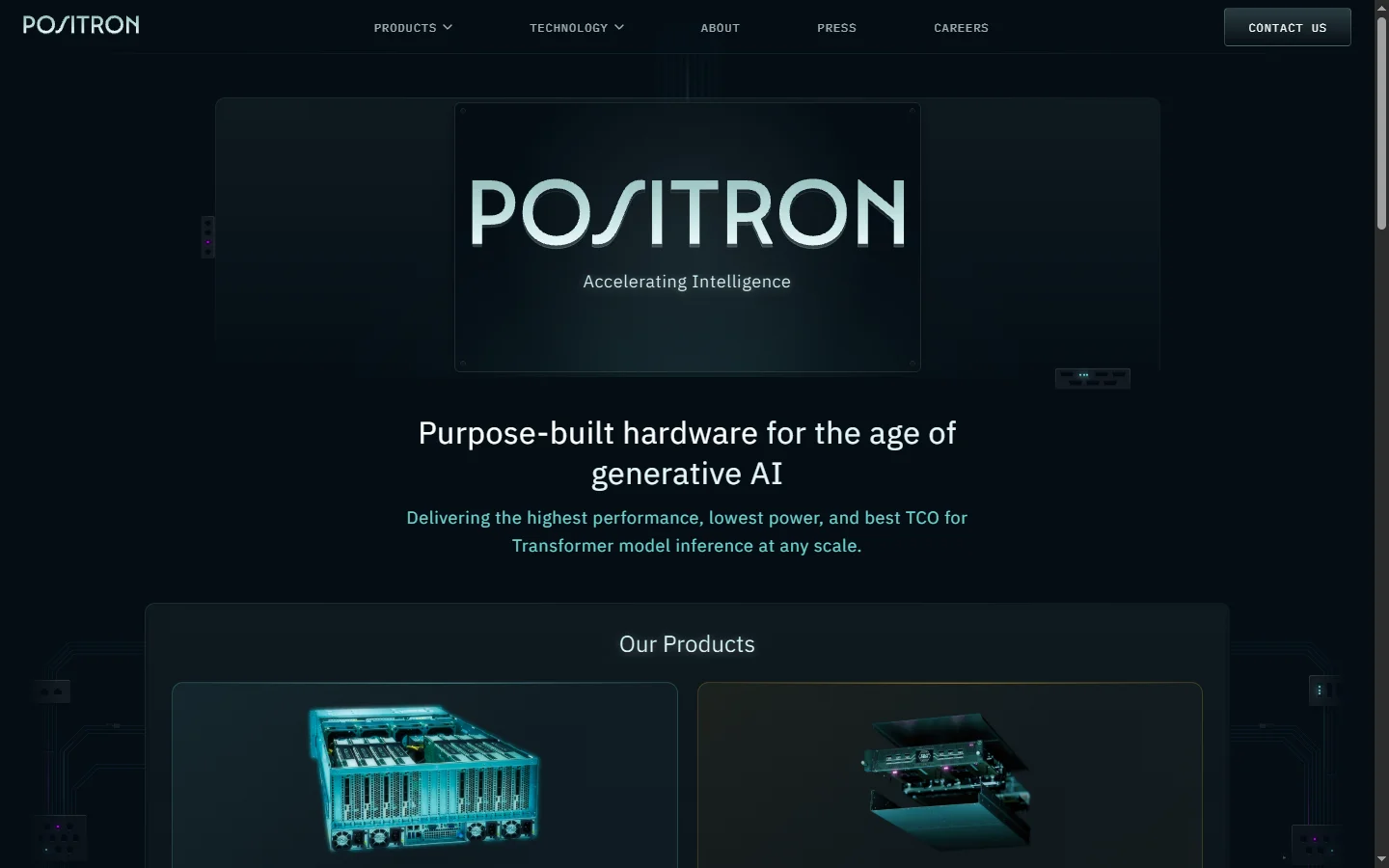
Positron AI designs and manufactures purpose-built inference appliances for running large language models in production. The company's Atlas systems combine custom silicon, optimized memory hierarchies, and a streamlined software stack tuned specifically for transformer inference rather than the general-purpose workloads GPUs handle. Positron AI customers — enterprises running their own LLMs behind a firewall, defense and government organizations, and hosting providers — deploy Atlas in their own data centers to serve LLMs at dramatically lower cost per token and higher throughput than equivalent NVIDIA-based setups.
The core technical insight is that LLM inference is memory-bandwidth bound rather than compute bound, and Positron AI's hardware design prioritizes exactly this characteristic. The result is an appliance that runs Llama, Mistral, Qwen, and other open-weight models significantly faster and more power-efficiently than a comparably priced GPU server. Positron AI also provides a software stack that handles model loading, quantization, batching, and API serving, so operators do not need to build a full inference platform from scratch.
Positron AI serves a specific niche — organizations that need to run LLMs on-premise for compliance, latency, or cost reasons and cannot or will not depend on hyperscaler cloud inference. Defense contractors, regulated industries, sovereign clouds, and cost-conscious AI application companies are typical customers. The appliance model reduces the expertise bar required to operate LLM inference infrastructure and delivers predictable performance at a fixed capital cost rather than variable cloud spend.
⚡ Key Features of Positron AI
Custom Inference Silicon
Positron AI's Atlas chips are designed specifically for transformer inference workloads, with a memory hierarchy and compute fabric optimized for the memory-bandwidth-bound nature of LLM generation. This specialization produces meaningful throughput and cost-per-token advantages over general-purpose GPUs at comparable price points. The silicon is domestically designed and manufactured, which matters for defense and government customers with sovereignty requirements.
High Throughput per Appliance
A single Atlas appliance can serve LLM inference at tokens-per-second rates that would require multiple GPU servers to match. This density reduces data center footprint, power consumption, and operational complexity for large deployments. Enterprises running internal LLMs at scale report significant reductions in infrastructure cost without sacrificing latency or quality.
On-Premise Deployment
Atlas appliances are deployed inside customer data centers, giving organizations full control over their LLM infrastructure without routing traffic to external cloud providers. This is essential for customers with data residency, compliance, or air-gapped deployment requirements. Defense, healthcare, financial services, and sovereign cloud operators are typical beneficiaries of the on-premise model.
OpenAI-Compatible API
The software stack exposes an OpenAI-compatible inference API so existing applications that call GPT models can be pointed at a Positron AI appliance with minimal code changes. This lets organizations migrate from cloud inference to on-premise Positron AI without rewriting their applications. Compatibility also extends to common open-source inference clients.
Support for Open-Weight Models
Atlas runs Llama, Mistral, Qwen, Gemma, and other popular open-weight model families out of the box, with pre-quantized variants tuned for Positron AI's hardware. Customers can also load custom fine-tunes of these models. This broad support means organizations can pick whichever model family best fits their use case without hardware lock-in to a single model.
Power and Cooling Efficiency
Because Atlas is optimized for inference rather than training, its power envelope is significantly lower than GPU servers running the same workloads. Data centers running many appliances benefit from reduced cooling and electrical infrastructure requirements. This efficiency advantage is particularly meaningful at scale, where power and cooling capacity are often the binding constraint on deployment growth.
Managed Inference Software
The software stack handles model loading, quantization, dynamic batching, KV-cache management, and API serving so operators do not need to assemble a full inference platform from open-source components. This managed approach reduces the specialized expertise required to operate the appliance and produces more predictable performance. The stack is updated over the air as Positron AI improves its optimizations.
🎯 Use Cases for Positron AI
⚖️ Positron AI Pros & Cons
Advantages
- ✓Significant cost-per-token advantage at scale
- ✓On-premise deployment for compliance and sovereignty
- ✓Higher throughput per appliance than equivalent GPU servers
- ✓Lower power and cooling requirements than GPU servers
- ✓OpenAI-compatible API for easy migration
Drawbacks
- ✗Only economical at meaningful inference volumes
- ✗Supports inference only, not training workloads
- ✗Open-weight model focus — not for proprietary-only shops
- ✗Capital expenditure model requires up-front budget
📖 How to Use Positron AI
Contact Positron AI at positron.ai to discuss your LLM inference workload, scale, and deployment requirements.
Complete a proof-of-concept with a cloud-hosted Atlas instance to validate performance and compatibility.
Work with Positron AI's field team to size the appliance footprint needed for your production workload.
Order Atlas appliances and install them in your data center or preferred colocation facility.
Point your LLM-using applications at the OpenAI-compatible API endpoint exposed by Atlas.
Monitor throughput, cost per token, and availability through the management console and scale the footprint as demand grows.
❓ Positron AI FAQ
Atlas runs large language model inference workloads on purpose-built silicon in customer data centers. It serves popular open-weight models like Llama, Mistral, and Qwen at higher throughput and lower cost per token than GPU-based servers.
No. Atlas is an inference appliance optimized for running LLMs, not training them. Customers use GPUs for training and then run production inference on Atlas to optimize cost and throughput.
Positron AI supports Llama, Mistral, Qwen, Gemma, and other popular open-weight model families out of the box. Customers can also load custom fine-tunes of these models onto Atlas.
Customers choose Positron AI for data sovereignty, compliance with regulations that restrict cloud data movement, predictable capital costs at scale, and cost-per-token advantages over cloud GPU inference at high volumes.
Yes. The Positron AI software stack exposes an OpenAI-compatible inference API so existing applications can be pointed at Atlas with minimal code changes.
Related to Positron AI

15.ai
15.ai is a free AI voice cloning tool famous for generating realistic speech from cartoon, video game, and animated show characters using as little as 15 seconds of source audio.

Abby AI
Abby AI is an AI therapy and mental wellness chatbot that offers CBT-informed conversations, mood tracking, and self-guided coping tools.

Accrete AI
Accrete AI builds autonomous enterprise AI agents for defense, government, and commercial intelligence workflows.

Ace AI
Ace AI is an AI-powered interview and career coach that helps job seekers prepare with mock interviews, resume feedback, and personalized career guidance.
Featured on WhatIf.ai
Add this badge to your website to show you're listed on WhatIf AI
Alternatives to Positron AI

Base44 AI
Base44 AI is an AI app builder and website builder that generates full-stack web applications from natural language descriptions with backend, database, and UI included.

Browse AI
Browse AI is a no-code web scraping and monitoring tool that extracts structured data from any website and tracks changes over time without writing code.


Cantina AI
Cantina AI is a freemium platform for building and deploying full-stack web applications using AI-assisted development with live preview and one-click deployment.

ChatGPT
ChatGPT AI assistant by OpenAI for writing, coding, research, image analysis, and everyday problem-solving.