
Pinecone AI
Freemium ✓ Verified 🔥 TrendingPinecone AI is a managed vector database optimized for high-performance semantic search, retrieval-augmented generation, and real-time AI applications.
📋 About Pinecone AI
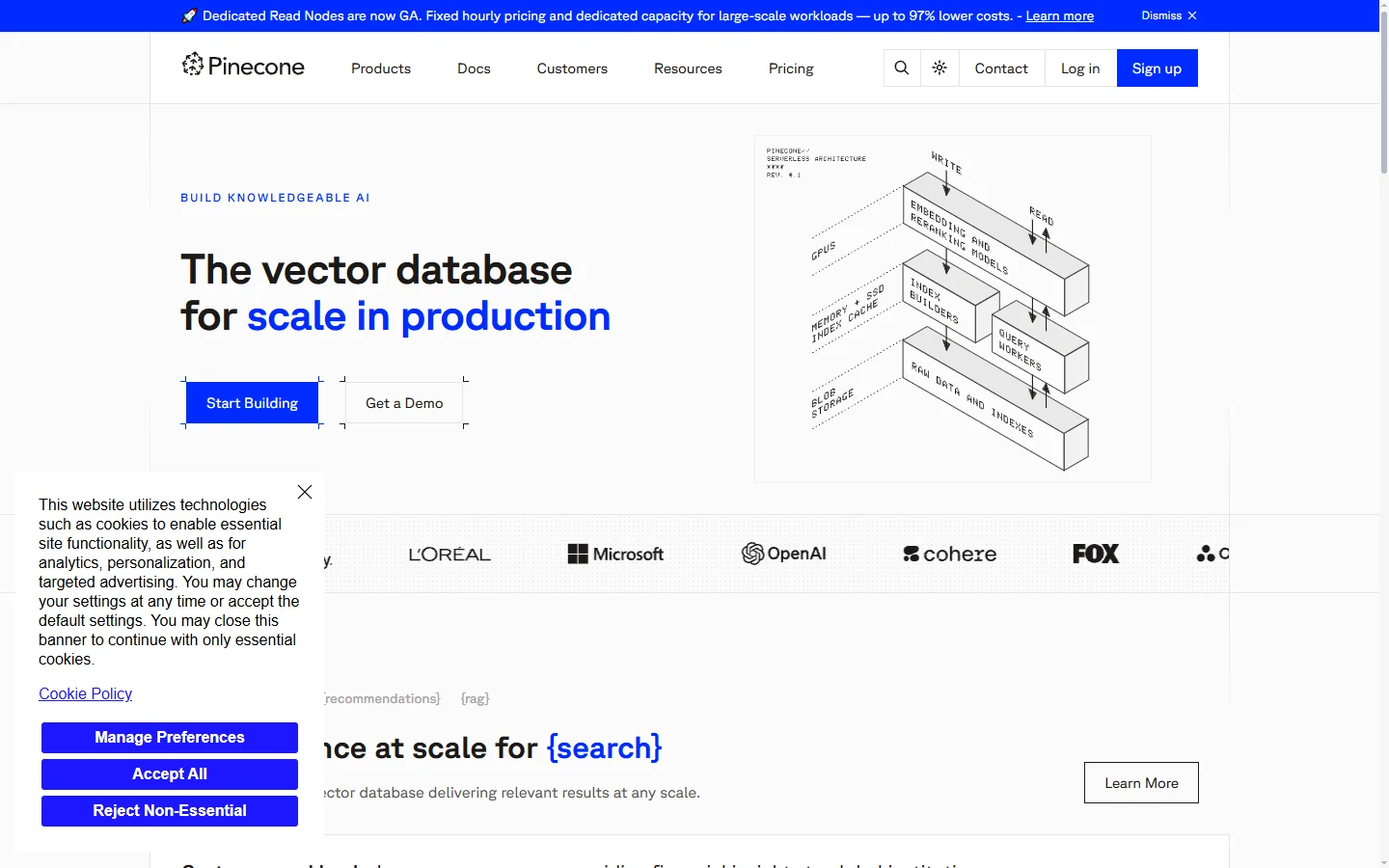
Pinecone AI is a fully managed vector database built specifically for production AI workloads that depend on fast, accurate similarity search across millions or billions of embeddings. As the foundational infrastructure under most enterprise retrieval-augmented generation systems, pinecone ai handles the operational complexity of sharding, replication, and index tuning so developers can focus on application logic rather than database administration. Its serverless architecture automatically scales query and storage capacity based on traffic, removing the capacity planning burden common to self-hosted alternatives.
The platform supports hybrid search that combines dense vector similarity with sparse keyword matching in a single query, which consistently produces better retrieval quality than either approach alone. Advanced filtering with metadata predicates lets applications restrict results by attributes like user ID, timestamp, or document source. Namespaces provide a clean multi-tenancy model that is essential for SaaS applications serving many customers from one backend. Integrations with major embedding model providers, LLM frameworks, and observability stacks make pinecone ai a natural choice across the modern AI development toolchain.
Pinecone AI serves the full range of vector-search-driven applications from chatbot memory and enterprise knowledge assistants to semantic product search, recommendation systems, and anomaly detection. Its customer base spans well-known AI-native startups and Fortune 500 enterprises deploying RAG pipelines at scale. Security features including SOC 2, HIPAA compatibility, and private networking options support regulated industries. The managed service positioning reduces total cost of ownership relative to operating open-source vector databases in-house, especially at scale.
⚡ Key Features of Pinecone AI
Serverless Vector Database
Pinecone ai runs as a fully managed service that automatically scales storage and query capacity based on traffic, so teams never provision shards or replicas manually. This serverless model eliminates the most common operational pain points of self-hosted vector databases. Cold-start performance is engineered to keep latency low for bursty workloads. Users pay for actual usage rather than peak provisioned capacity, which keeps costs aligned with real application traffic.
Hybrid Dense and Sparse Search
Single queries can combine dense vector similarity with sparse BM25-style keyword matching, which consistently outperforms either approach alone for real-world retrieval. This hybrid mode is particularly valuable for domain-specific content where exact term matches matter alongside semantic meaning. The system blends scores intelligently rather than running two separate searches. Weights can be tuned to prefer one signal over the other based on the use case.
Metadata Filtering
Every vector can be tagged with structured metadata used for high-performance filtering at query time — restricting results by user, timestamp, source document, language, or any application-specific attribute. Complex predicate expressions with AND, OR, and comparisons are evaluated efficiently alongside similarity ranking. This is critical for multi-tenant applications that must not leak data between users and for time-sensitive retrieval that should exclude stale content. Metadata can be updated in place without recomputing embeddings.
Namespaces for Multi-Tenancy
Namespaces provide a lightweight partitioning mechanism that isolates data for different customers, projects, or environments without provisioning separate indexes. Queries target a specific namespace, ensuring clean isolation and predictable performance per tenant. This is significantly simpler than managing dozens of indexes and aligns well with SaaS architectures. Administrators can enforce per-namespace quotas and retention policies.
Enterprise Security and Compliance
Pinecone ai holds SOC 2 Type II certification, supports HIPAA-compatible deployments, and offers private networking, customer-managed encryption keys, and strict data residency controls. Role-based access control and audit logging meet enterprise governance requirements. These features enable adoption in regulated sectors like healthcare, financial services, and government. Security certifications are maintained continuously as part of the managed service.
Broad Ecosystem Integration
Native integrations with LangChain, LlamaIndex, Haystack, OpenAI, Cohere, and other frameworks let developers drop Pinecone into existing AI pipelines with minimal code. SDKs are available for Python, Node.js, Go, and other major languages. Observability integrations surface query patterns and index health in tools teams already use. This ecosystem breadth reduces integration time from weeks to hours for common stacks.
Real-Time Indexing and Updates
Vectors can be upserted, updated, or deleted with sub-second visibility in query results, supporting live applications where content changes continuously. This is essential for use cases like chatbot memory, user personalization, and news retrieval where stale indexes harm user experience. Batch operations support efficient bulk loading during initial corpus ingestion. Change data capture patterns integrate with streaming sources for continuous synchronization.
🎯 Use Cases for Pinecone AI
⚖️ Pinecone AI Pros & Cons
Advantages
- ✓Fully managed — no cluster operations required
- ✓Serverless scaling with pay-per-use pricing
- ✓Hybrid dense and sparse search improves retrieval quality
- ✓Strong ecosystem integrations across AI toolchains
- ✓Enterprise security including SOC 2 and HIPAA support
Drawbacks
- ✗Costs can grow quickly at very large vector volumes
- ✗Less configurable than self-hosted open-source alternatives
- ✗Vendor lock-in concerns for some organizations
- ✗Complex billing model can be hard to forecast
📖 How to Use Pinecone AI
Sign up at pinecone.io and create a free-tier account to begin experimenting with indexes and sample datasets.
Create a new serverless index specifying vector dimension, distance metric, and cloud region.
Generate embeddings with your preferred model provider such as OpenAI, Cohere, or a local model.
Upsert vectors with associated metadata using the Python, Node.js, or other SDK of your choice.
Query the index with a vector plus optional metadata filters and namespace to retrieve the most similar results.
Integrate query responses into your RAG, search, or recommendation application and monitor performance in the Pinecone console.
❓ Pinecone AI FAQ
Pinecone ai is a managed vector database used to power semantic search, retrieval-augmented generation, recommendation systems, anomaly detection, and any AI application that relies on similarity search over embeddings.
Pinecone offers a free starter tier suitable for prototyping and small projects. Production workloads typically use paid serverless or dedicated plans priced by storage and query volume.
Pinecone trades some configurability for fully managed operations, automatic scaling, and enterprise compliance features. Self-hosted options like Weaviate, Qdrant, and Milvus offer more customization but require infrastructure management.
Yes. Pinecone supports hybrid search that combines dense vector similarity with sparse keyword matching in a single query, which improves retrieval quality for most real-world content types.
Yes. Pinecone holds SOC 2 Type II certification, supports HIPAA-compatible deployments, and offers private networking and customer-managed encryption keys for regulated healthcare, financial services, and government workloads.
Related to Pinecone AI

Accrete AI
Accrete AI builds autonomous enterprise AI agents for defense, government, and commercial intelligence workflows.

Ace AI
Ace AI is an AI-powered interview and career coach that helps job seekers prepare with mock interviews, resume feedback, and personalized career guidance.

Actively AI
Actively AI is an AI sales prospecting platform that researches accounts, identifies buyer signals, and writes personalized outbound at pipeline scale.

Airship AI
Airship AI provides video intelligence and data management solutions that use AI to search, analyze, and secure large-scale video evidence.
Featured on WhatIf.ai
Add this badge to your website to show you're listed on WhatIf AI
Alternatives to Pinecone AI

Base44 AI
Base44 AI is an AI app builder and website builder that generates full-stack web applications from natural language descriptions with backend, database, and UI included.

Browse AI
Browse AI is a no-code web scraping and monitoring tool that extracts structured data from any website and tracks changes over time without writing code.


Cantina AI
Cantina AI is a freemium platform for building and deploying full-stack web applications using AI-assisted development with live preview and one-click deployment.

ChatGPT
ChatGPT AI assistant by OpenAI for writing, coding, research, image analysis, and everyday problem-solving.