
Mythic AI
Paid ✓ VerifiedMythic AI is a semiconductor company building analog compute-in-memory AI chips that deliver high performance-per-watt for edge inference workloads.
📋 About Mythic AI
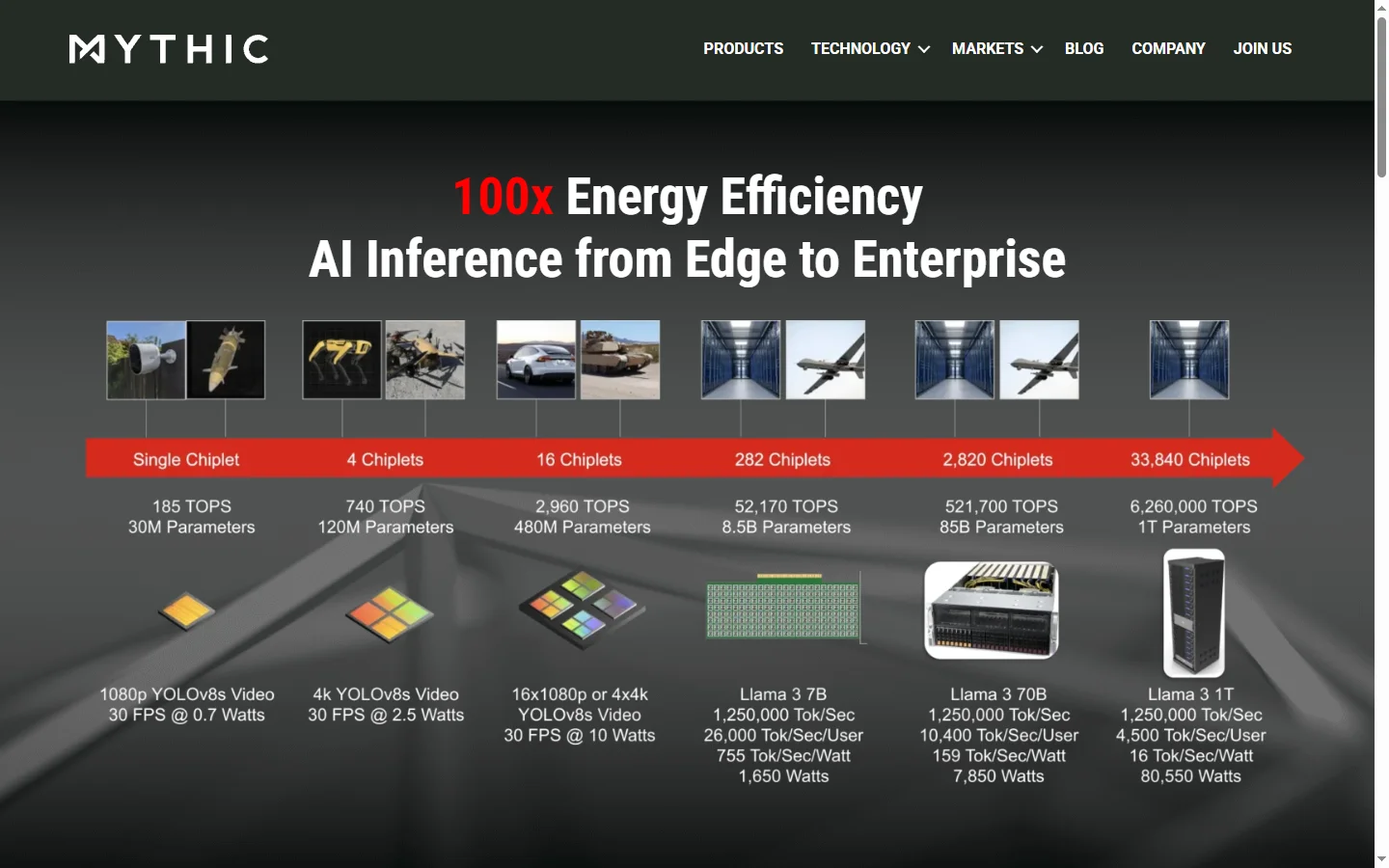
Mythic AI is a semiconductor company pioneering analog compute-in-memory AI chips that perform neural network inference directly inside flash memory arrays, dramatically reducing the power and latency costs of data movement that dominate digital AI accelerators. Rather than shuttling model weights between memory and compute on every operation — the fundamental bottleneck of conventional chip architectures — Mythic's analog matrix processor executes multiply-accumulate operations in place using the physics of flash transistors, which it claims delivers an order-of-magnitude advantage in performance-per-watt on edge inference workloads compared with digital accelerators of similar capability.
The company's products target edge deployments where power budgets are tight and latency matters — smart cameras, industrial sensors, autonomous robotics, defense applications, and consumer devices — rather than the hyperscaler data center segment dominated by GPU vendors. Mythic provides a PCIe form factor for server-class edge inference and the M1076 analog matrix processor for smaller embedded applications, along with a software toolchain that compiles PyTorch and TensorFlow models to the analog hardware with quantization-aware training built in. The novelty of analog compute requires specific compilation approaches, but Mythic abstracts most of that complexity from model developers.
Mythic AI targets designers of edge AI products — smart city infrastructure, industrial IoT, security systems, autonomous machines, aerospace and defense systems — where the power and heat profile of GPU-class accelerators is impractical. The company is not aimed at general-purpose cloud inference; instead, it competes in the edge AI chip segment against vendors like NXP, NVIDIA Jetson, and specialized neural accelerators. Compute-in-memory remains a relatively young commercial technology, so Mythic's positioning also involves evangelism of the analog approach as a credible architecture for production deployment rather than a research curiosity.
⚡ Key Features of Mythic AI
Analog Compute-in-Memory Architecture
Mythic's core innovation is performing matrix multiply operations directly inside flash memory cells using analog circuits, eliminating the data movement between memory and compute that dominates energy use in digital accelerators. This produces what the company positions as order-of-magnitude improvements in performance-per-watt on neural network inference, which is the key constraint in many edge AI deployments.
M1076 Analog Matrix Processor
The M1076 is Mythic's flagship chip targeting embedded and edge systems, delivering substantial neural inference capability within a power envelope small enough for battery-powered and thermally constrained products. The chip integrates memory, compute, and data movement in a single package, which simplifies system design for product developers who would otherwise need to architect around GPU-style accelerators.
Server-Class PCIe Edge Inference Cards
For edge servers running multiple concurrent inference streams — multi-camera video analytics, industrial fleet monitoring, retail analytics — Mythic offers PCIe-format cards that slot into standard servers with dramatically lower power draw than GPU-based alternatives. This enables edge server form factors that would not be thermally feasible with GPUs in many deployment environments.
PyTorch and TensorFlow Toolchain
Mythic provides a software stack that compiles standard PyTorch and TensorFlow models to the analog hardware, with quantization-aware training and analog-specific optimization built in. Model developers do not need to understand the underlying analog compute details — the compiler handles the translation from standard model formats to the analog instruction representation the chip executes.
High Performance-per-Watt Claims
By eliminating the memory-compute data movement that dominates digital accelerator energy use, Mythic claims substantial improvements in performance-per-watt for edge inference relative to GPU and digital NPU alternatives. This is the primary decision factor for customers in battery-powered, fanless, or thermally constrained edge deployments where raw compute density matters less than efficiency.
Edge-First Product Strategy
Unlike chip competitors that target hyperscaler data centers, Mythic focuses on edge deployments — smart cameras, autonomous machines, industrial sensors, defense and aerospace systems — where its power efficiency advantage is most valuable. This positioning avoids direct competition with the entrenched GPU ecosystem in cloud AI and aligns with a segment of the AI chip market that is expected to grow rapidly as inference migrates closer to data sources.
🎯 Use Cases for Mythic AI
⚖️ Mythic AI Pros & Cons
Advantages
- ✓Order-of-magnitude efficiency claims for edge inference
- ✓Compiles standard PyTorch and TensorFlow models automatically
- ✓Compact, low-power form factors fit constrained edge products
- ✓Differentiated analog compute architecture vs. digital accelerators
- ✓Focused edge-AI positioning avoids entrenched GPU competition
Drawbacks
- ✗Analog compute is a relatively young commercial technology
- ✗Smaller ecosystem and software maturity than GPU platforms
- ✗Model quantization and analog precision require careful validation
- ✗Not designed for training or hyperscaler inference workloads
📖 How to Use Mythic AI
Visit mythic.ai and contact the sales team with your edge AI product concept, target power envelope, and model requirements.
Evaluate Mythic's software toolchain by compiling your target model to the analog representation and reviewing accuracy and performance projections.
Order developer kits or evaluation boards to benchmark real-world inference performance and power consumption on your workload.
Work with Mythic solution engineers on quantization-aware training and model tuning to ensure accuracy meets production requirements.
Plan product integration through Mythic's PCIe cards for edge servers or the M1076 processor for embedded designs.
Engage Mythic support during product qualification, production ramp, and ongoing deployment for firmware and toolchain updates.
❓ Mythic AI FAQ
Analog compute-in-memory performs neural network operations directly inside memory arrays using the physics of flash transistors, rather than moving weights between memory and digital compute on every operation. This eliminates the data movement energy that dominates conventional accelerators, yielding substantial efficiency gains on inference workloads.
Mythic chips are designed for inference, specifically edge inference where power efficiency is the binding constraint. The company does not target large-scale model training, which remains dominated by GPU-based systems.
Use standard PyTorch or TensorFlow to train your model, then compile it to the Mythic analog representation using the company's software toolchain. Quantization-aware training and analog-specific optimization are built into the toolchain, so most of the analog-specific complexity is abstracted from model developers.
Product developers in smart cameras, industrial IoT, robotics, aerospace and defense, retail analytics, and medical devices — segments where edge inference power budgets rule out GPU-class accelerators. Mythic does not target hyperscaler cloud data centers.
NVIDIA Jetson is a digital GPU-based edge AI platform with a large, mature software ecosystem. Mythic uses analog compute-in-memory to target better performance-per-watt on edge inference, at the cost of smaller ecosystem and newer technology maturity. Customers choose based on whether efficiency or ecosystem breadth is the binding constraint.
Related to Mythic AI

15.ai
15.ai is a free AI voice cloning tool famous for generating realistic speech from cartoon, video game, and animated show characters using as little as 15 seconds of source audio.

Abby AI
Abby AI is an AI therapy and mental wellness chatbot that offers CBT-informed conversations, mood tracking, and self-guided coping tools.

Accrete AI
Accrete AI builds autonomous enterprise AI agents for defense, government, and commercial intelligence workflows.

Ace AI
Ace AI is an AI-powered interview and career coach that helps job seekers prepare with mock interviews, resume feedback, and personalized career guidance.

Actively AI
Actively AI is an AI sales prospecting platform that researches accounts, identifies buyer signals, and writes personalized outbound at pipeline scale.

Furiosa AI
Furiosa AI is a South Korean semiconductor company designing high-performance AI accelerator chips optimized for large language model inference.
Featured on WhatIf.ai
Add this badge to your website to show you're listed on WhatIf AI
Alternatives to Mythic AI
15.ai
15.ai is a free AI voice cloning tool famous for generating realistic speech from cartoon, video game, and animated show characters using as little as 15 seconds of source audio.

Abby AI
Abby AI is an AI therapy and mental wellness chatbot that offers CBT-informed conversations, mood tracking, and self-guided coping tools.

Accrete AI
Accrete AI builds autonomous enterprise AI agents for defense, government, and commercial intelligence workflows.

Ace AI
Ace AI is an AI-powered interview and career coach that helps job seekers prepare with mock interviews, resume feedback, and personalized career guidance.