
Kumo AI
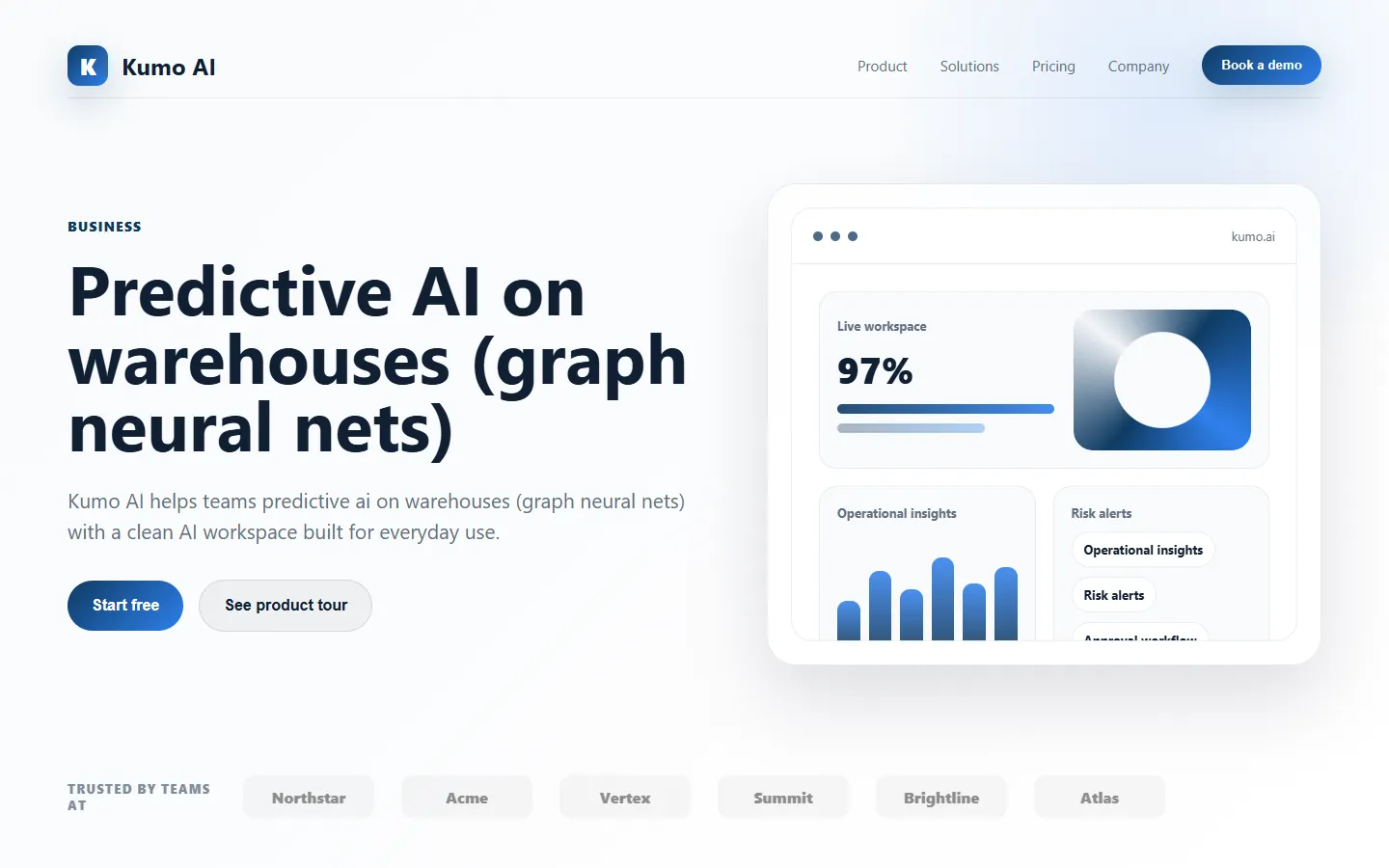
Paid ✓ VerifiedKumo AI is a predictive AI platform that runs graph neural networks directly on enterprise data warehouses to forecast business outcomes.
📋 About Kumo AI
Kumo AI is an enterprise predictive AI platform that brings graph neural networks to the data warehouse, enabling companies to predict customer behavior, revenue outcomes, fraud risk, and other critical business metrics without building a full ML pipeline. The platform connects directly to Snowflake, Databricks, BigQuery, and Redshift, understands the relationships in the warehouse's table schema, and trains a graph neural network on that structure to produce predictions that traditional tabular ML cannot match.
What sets Kumo AI apart is its ability to leverage the inherent graph structure of business data — customers are connected to orders, orders to products, products to categories — rather than flattening everything into a single wide table. This graph-native approach captures relationship signals that make predictions significantly more accurate, particularly for problems like churn prediction, lifetime value, and next-purchase recommendation. The platform automates feature engineering, which is typically the most time-consuming part of building predictive models, and produces production-ready predictions within days rather than the months a custom ML project would require.
Kumo AI is used by large retailers, financial services firms, and B2B SaaS companies that have rich warehouse data but lack the specialized ML engineering resources to build graph models from scratch. The founding team includes several pioneers of the graph neural network field, including researchers who built influential libraries like PyTorch Geometric. Enterprise customers get results that previously required a dedicated ML team, delivered through an interface that data analysts and SQL-literate business users can operate directly.
⚡ Key Features of Kumo AI
Graph Neural Networks on Warehouse Data
Kumo AI runs graph neural networks directly on the relational structure of enterprise data warehouses. Rather than flattening tables into wide feature vectors, Kumo AI preserves the relationships between customers, orders, products, and other entities, which captures signals that dramatically improve prediction accuracy. This graph-native approach is particularly powerful for problems like churn prediction, lifetime value, and recommendation.
Automated Feature Engineering
The platform automates the feature engineering that typically consumes 80% of a data science team's time. Kumo AI examines the warehouse schema, infers meaningful features from table relationships, and constructs inputs to the model without manual data preparation. This automation compresses months of work into days and removes a major bottleneck for enterprises that lack deep ML engineering resources.
Direct Warehouse Integration
Kumo AI connects directly to Snowflake, Databricks, BigQuery, and Redshift, running training and inference on data without copying it out of the warehouse. This is critical for compliance, data residency, and operational simplicity — the data never moves. Predictions are written back to warehouse tables that downstream systems can consume. This warehouse-native model fits how modern enterprise data teams actually work.
SQL-Like Predictive Query Language
Users define prediction problems using a SQL-like query language that specifies the entity to predict on, the outcome to forecast, and the time window. This approach is accessible to data analysts and SQL-literate business users, not just ML engineers. A churn prediction that would require thousands of lines of code in a traditional ML pipeline can be expressed in a few lines of Kumo AI's query syntax.
Explainable Predictions
Predictions come with explanations that identify which entities and signals most influenced the result — a specific customer's churn risk might be driven by decreased usage in the last 30 days and a failed payment last month. This explainability is essential for business stakeholders who need to understand and trust the model's outputs before acting on them. Without explainability, predictive models often go unused.
Scheduled Batch Predictions
Predictions can be scheduled to run on a cadence — daily churn risk, weekly lifetime value updates, real-time fraud scoring — with results written to warehouse tables that downstream systems consume. This makes Kumo AI a production prediction engine rather than a one-off analysis tool. Marketing, customer success, and finance systems consume these predictions to drive operational decisions.
Enterprise Security and Compliance
Kumo AI is designed for enterprise deployment with SOC 2 compliance, SSO, role-based access control, and data never leaving the customer's warehouse. This posture satisfies the compliance requirements of financial services, healthcare, and other regulated industries that would not otherwise adopt external predictive AI platforms. Audit logs and governance features support regulated use cases.
🎯 Use Cases for Kumo AI
⚖️ Kumo AI Pros & Cons
Advantages
- ✓Graph neural networks capture signals tabular ML misses
- ✓Warehouse-native — data never leaves Snowflake or Databricks
- ✓Automated feature engineering removes a major bottleneck
- ✓SQL-like interface accessible to analysts, not just ML engineers
- ✓Explainable predictions build business stakeholder trust
Drawbacks
- ✗Enterprise-only pricing rules out small companies
- ✗Requires a mature data warehouse to be useful
- ✗Graph model training can be computationally expensive
- ✗Limited to predictive tasks — not generative AI
📖 How to Use Kumo AI
Contact Kumo AI at kumo.ai to schedule a discovery call and scope your predictive use cases.
Connect Kumo AI to your data warehouse — Snowflake, Databricks, BigQuery, or Redshift.
Describe your first prediction problem using Kumo AI's SQL-like predictive query language.
Train the graph neural network — Kumo AI handles feature engineering and model tuning automatically.
Review prediction accuracy and explanations with business stakeholders before deploying to production.
Schedule predictions to run on a cadence, with results written back to warehouse tables for downstream systems to consume.
❓ Kumo AI FAQ
Kumo AI is an enterprise predictive AI platform that runs graph neural networks directly on data warehouses like Snowflake, Databricks, BigQuery, and Redshift to forecast business outcomes such as churn, lifetime value, and fraud risk.
Graph neural networks capture the relationships between entities — customers, orders, products, accounts — that tabular ML loses when data is flattened into wide feature vectors. This typically produces significantly more accurate predictions for relational business problems.
No. Kumo AI runs training and inference directly on data inside Snowflake, Databricks, BigQuery, or Redshift. Data never leaves the warehouse, which supports compliance, data residency, and operational simplicity.
Kumo AI solves predictive problems on relational data — churn prediction, lifetime value, next-purchase recommendation, fraud scoring, credit risk, equipment failure, and more. It is not a generative AI platform.
Pricing is custom based on warehouse size, prediction volume, and features used. Kumo AI is designed for enterprise customers and does not have a self-serve pricing tier for small companies.
Related to Kumo AI

Accrete AI
Accrete AI builds autonomous enterprise AI agents for defense, government, and commercial intelligence workflows.

Ace AI
Ace AI is an AI-powered interview and career coach that helps job seekers prepare with mock interviews, resume feedback, and personalized career guidance.

Actively AI
Actively AI is an AI sales prospecting platform that researches accounts, identifies buyer signals, and writes personalized outbound at pipeline scale.

Airship AI
Airship AI provides video intelligence and data management solutions that use AI to search, analyze, and secure large-scale video evidence.

H2O AI
H2O AI is an enterprise AI and machine learning platform offering AutoML, generative AI, and an end-to-end MLOps stack for data science teams at scale.
Featured on WhatIf.ai
Add this badge to your website to show you're listed on WhatIf AI
Alternatives to Kumo AI

Arcads AI
Arcads AI generates UGC-style video ads using AI actors from scripts, enabling performance marketers to produce ad creative variations at scale.


Blaze AI
Blaze AI generates on-brand social media posts, blog articles, email campaigns, and ad copy for marketers and small businesses using configurable brand voice settings.


Chalkie AI
Chalkie AI creates lesson plans, worksheets, quizzes, and differentiated materials mapped to curriculum standards for teachers and tutors.

ChatGPT
ChatGPT AI assistant by OpenAI for writing, coding, research, image analysis, and everyday problem-solving.