
Portkey AI
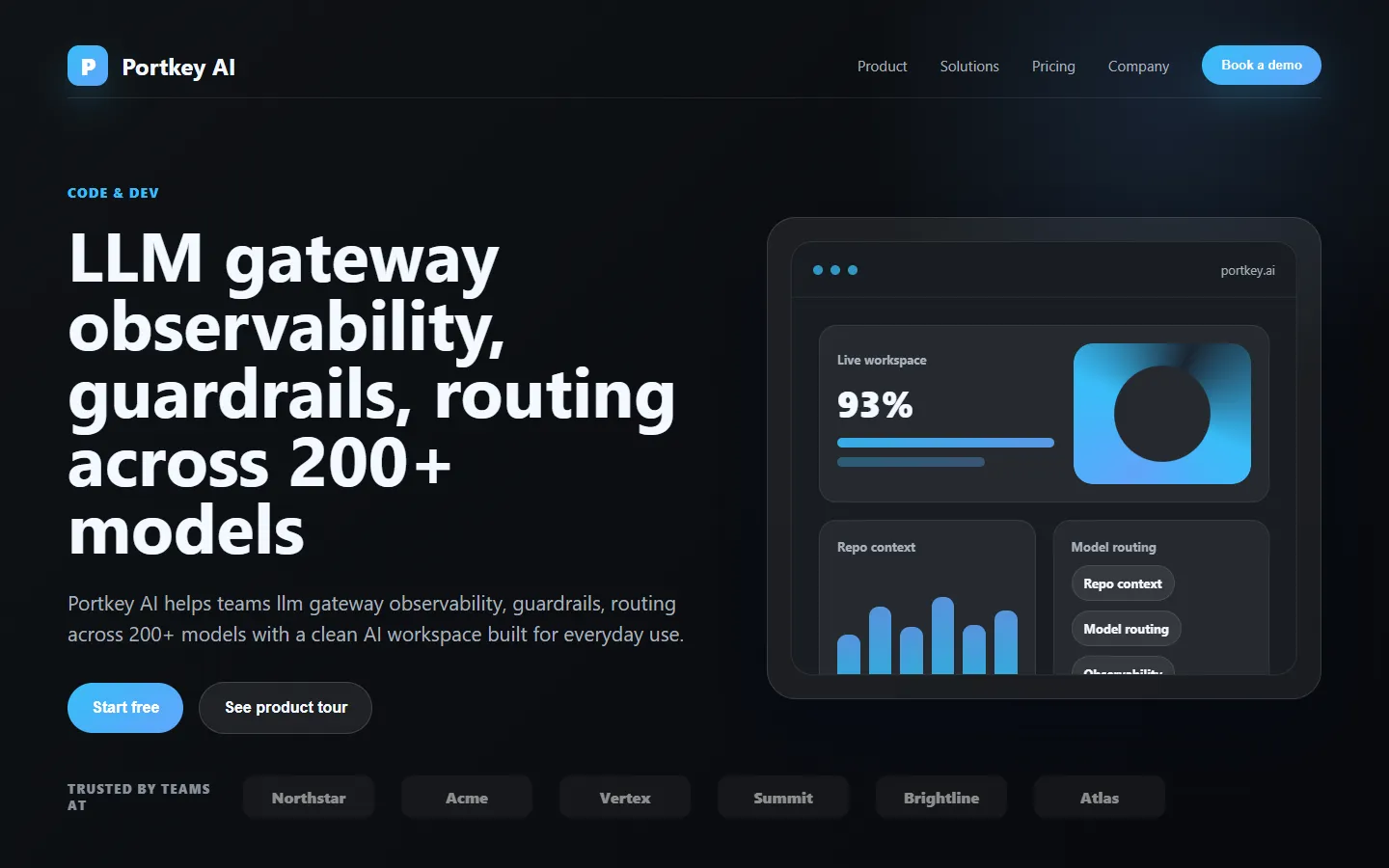
Freemium ✓ Verified 🔥 TrendingPortkey AI is an LLM gateway and control plane for observability, guardrails, routing, and cost control across 200+ AI models.
📋 About Portkey AI
Portkey AI is an LLM gateway and control plane that sits between applications and foundation models. Through a single, OpenAI-compatible API, developers can call more than 200 models — OpenAI, Anthropic, Google, Mistral, Cohere, local Ollama, and many others — while gaining observability, guardrails, caching, cost controls, and fine-grained routing. This removes the sprawl of direct model integrations and gives engineering, SRE, and security teams a consistent layer to govern AI usage.
The Portkey AI platform instruments every request with traces, token counts, latency measurements, and cost attribution. Guardrails can check inputs and outputs for PII, policy violations, or hallucinations before they reach users or get logged. Smart routing sends each call to the most cost-effective or highest-quality model based on configurable rules, with automatic fallback on failures. Prompt management and versioning close the loop so production improvements stay tied to specific prompt versions.
Portkey AI serves AI-native startups and enterprises shipping LLM-powered products that need reliability, security, and cost control in production. Customers use it to cut LLM costs meaningfully, prevent data-loss incidents, debug slow pipelines, and safely migrate between models as the field evolves. Its developer-first design — SDKs in every major language and near-zero added latency — makes adoption straightforward even in high-throughput environments.
⚡ Key Features of Portkey AI
Unified LLM Gateway
One OpenAI-compatible endpoint gives access to more than 200 models across providers, letting teams swap or combine models without rewriting application code. This eliminates per-provider SDK fragmentation and makes future model migrations trivial. It is the backbone that everything else builds on.
Observability and Tracing
Every LLM call is traced with prompts, responses, token counts, latency, and cost, giving engineering and finance teams full visibility into AI usage. Traces integrate with OpenTelemetry and existing APM tools. Debugging slow or failing pipelines becomes trivial.
Guardrails for Safety and Compliance
Pre- and post-processing guardrails check inputs and outputs for PII, toxic content, prompt injection, and policy violations. Violating requests can be blocked, redacted, or routed for human review. This is essential for enterprise and regulated deployments.
Intelligent Routing and Fallbacks
Configurable rules route each request to the most appropriate model by cost, latency, or quality, with automatic fallback to alternative models when a provider fails. This dramatically improves reliability and reduces bill shock during provider outages or price changes.
Semantic Caching
Portkey AI caches responses based on semantic similarity, not just exact match, cutting repeat-query costs significantly in production systems. Cache rules are tunable per endpoint or user segment to balance freshness and savings. Measurable cost reductions often justify adoption on their own.
Prompt Management and Versioning
Teams manage prompts centrally with versioning, A/B testing, and rollbacks, decoupling prompt improvements from application deploys. Non-engineers can iterate on prompts without waiting for the next release. Every production change is auditable.
Budgets, Rate Limits, and Access Control
Set budgets and rate limits per team, project, or user, and enforce access control policies on which models and features each group can use. This turns AI usage from a wild-west cost center into a governed service. Administrators see real-time spend and can intervene before overruns.
🎯 Use Cases for Portkey AI
⚖️ Portkey AI Pros & Cons
Advantages
- ✓Single API for 200+ models simplifies integration
- ✓Strong observability and cost attribution
- ✓Guardrails meet enterprise security needs
- ✓Semantic caching cuts bills measurably
- ✓Generous free tier for early-stage use
Drawbacks
- ✗Adds a network hop — latency impact usually small but non-zero
- ✗Advanced features require paid plans
- ✗Some provider-specific features must still go direct
- ✗Learning curve to fully exploit routing and guardrail rules
📖 How to Use Portkey AI
Sign up at portkey.ai and create an API key.
Replace your OpenAI-compatible base URL with Portkey AI's gateway in your code.
Configure virtual keys for each provider and model you want to use.
Enable observability, semantic caching, and guardrails in the dashboard.
Define routing rules and fallbacks to balance cost and reliability.
Monitor spend, latency, and failure rates, and iterate on prompts and rules.
❓ Portkey AI FAQ
Portkey AI is an LLM gateway and control plane that provides a single API for 200+ models along with observability, guardrails, routing, caching, and cost controls for production AI applications.
Yes. Portkey AI offers a generous free tier for early-stage and hobbyist use. Paid plans unlock higher throughput, enterprise security features, and advanced analytics.
Portkey AI logs requests and responses by default for observability, with configurable retention, redaction, and opt-out for sensitive endpoints. Enterprise plans support private deployments where data never leaves the customer environment.
Portkey AI adds minimal overhead, typically well under one hundred milliseconds. For most production apps, the observability and reliability gains significantly outweigh the added hop.
Yes. Semantic caching, intelligent routing to cheaper models, and budget enforcement typically reduce LLM bills meaningfully — often in the 20-50% range depending on workload characteristics.
Related to Portkey AI

A2E AI
A2E AI productivity platform converts audio and video recordings into transcripts, summaries, and action items with speaker identification.

Abnormal AI
Abnormal AI uses behavioral AI to detect business email compromise, account takeover, and socially engineered phishing that bypasses secure email gateways.

Abridge AI
Abridge AI medical documentation platform that records and summarizes clinical conversations into structured physician notes in real time.

Accrete AI
Accrete AI builds autonomous enterprise AI agents for defense, government, and commercial intelligence workflows.

ChatGPT
ChatGPT AI assistant by OpenAI for writing, coding, research, image analysis, and everyday problem-solving.

Claude
Claude AI assistant by Anthropic with a 200K context window, strong reasoning, and safety-focused design for writing, coding, and analysis.
Featured on WhatIf.ai
Add this badge to your website to show you're listed on WhatIf AI
Alternatives to Portkey AI

A2E AI
A2E AI productivity platform converts audio and video recordings into transcripts, summaries, and action items with speaker identification.
Abnormal AI
Abnormal AI uses behavioral AI to detect business email compromise, account takeover, and socially engineered phishing that bypasses secure email gateways.

Abridge AI
Abridge AI medical documentation platform that records and summarizes clinical conversations into structured physician notes in real time.

Air AI
Air AI conducts autonomous full-length AI phone calls for sales prospecting, appointment setting, and customer service without human agents.