
OpenEvidence
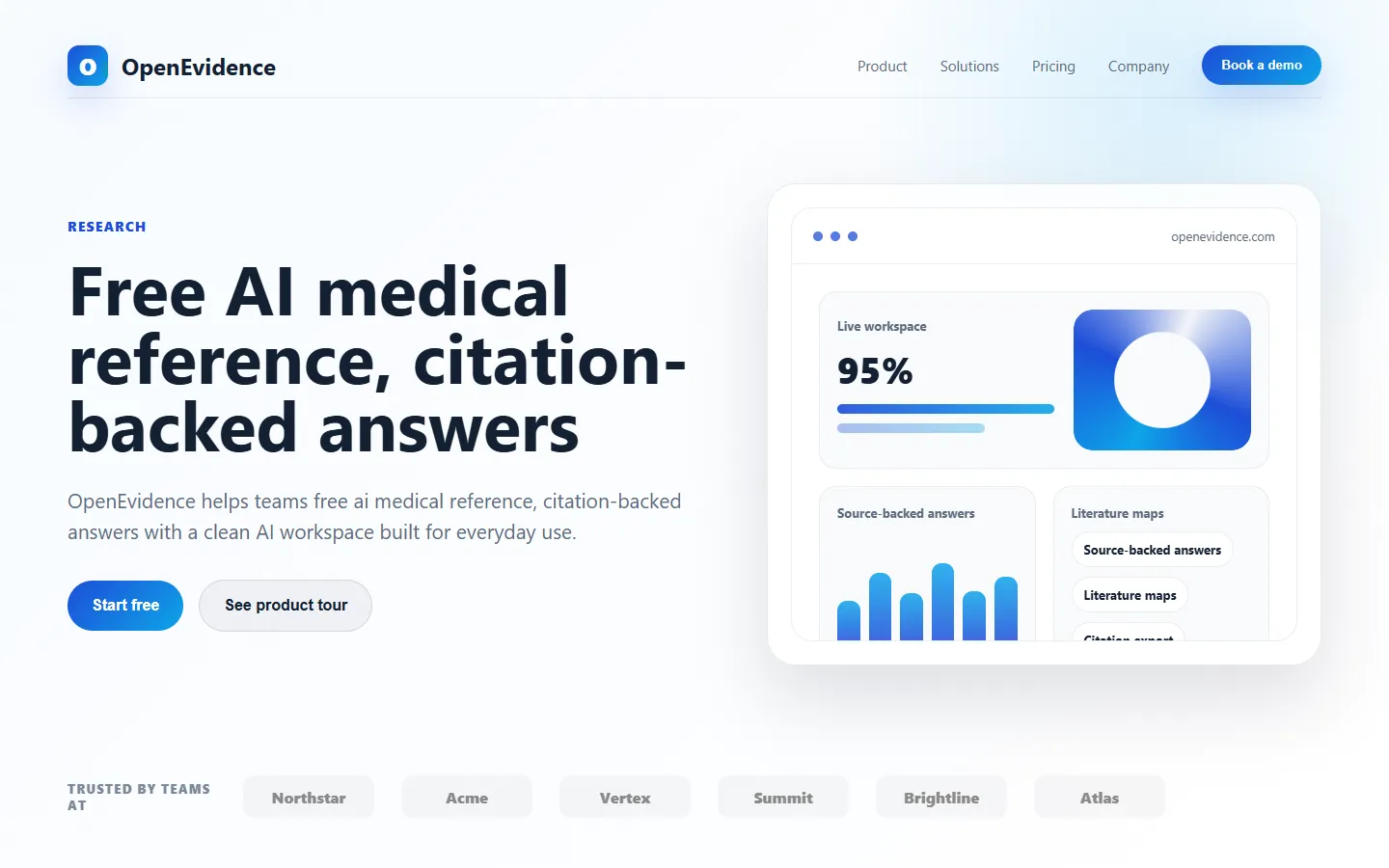
FreeOpenEvidence is a free AI medical reference for clinicians that delivers citation-backed answers from peer-reviewed literature and major medical journals.
📋 About OpenEvidence
OpenEvidence is an AI-powered medical reference tool built specifically for physicians, nurse practitioners, physician assistants, and other licensed clinicians who need rapid, evidence-based answers at the point of care. Unlike general-purpose chatbots, OpenEvidence grounds every response in peer-reviewed biomedical literature and cites the specific sources — journal articles, clinical trials, guidelines, and systematic reviews — that support each statement. This makes it safer to use in clinical workflows where hallucinated information can directly harm patients.
The platform is developed in collaboration with the New England Journal of Medicine, Mayo Clinic Proceedings, and other respected publishers, giving it licensed access to high-quality primary literature that many AI tools cannot legally ingest. Clinicians type a specific clinical question — about a diagnostic workup, drug dosing adjustment, differential diagnosis, or guideline interpretation — and receive a structured response with inline citations linking directly to the relevant abstracts or full-text articles. The answers are tuned to clinical relevance rather than academic completeness, making them practical between patient visits.
OpenEvidence is free for verified US healthcare professionals, funded through partnerships with publishers and sponsored research content rather than user subscriptions. This model makes it accessible to residents, rural practitioners, and solo providers who lack expensive institutional UpToDate subscriptions. It serves as an AI-native complement to traditional clinical decision support tools, and is particularly valued for time-pressed scenarios — hospital rounds, emergency department shifts, and primary care visits — where searching multiple references manually is impractical.
⚡ Key Features of OpenEvidence
Citation-Backed Clinical Answers
Every response OpenEvidence generates includes inline citations that link directly to the peer-reviewed sources supporting each claim. Clinicians can click through to verify context, check study methodology, or read the primary source before applying the information to patient care. This traceability is the core safety feature that separates OpenEvidence from general chatbots and is essential for defensible clinical decision-making.
Licensed Access to NEJM and Major Journals
OpenEvidence has formal content partnerships with the New England Journal of Medicine, Mayo Clinic Proceedings, and other leading medical publishers, giving it licensed access to articles that many AI tools cannot legally index. This means answers can cite and link directly to authoritative primary sources, including NEJM review articles and original trials, rather than secondary summaries.
Clinical Question Interface Tuned for Workflow
The query interface is designed for clinical shorthand — users can type natural-language questions like 'appropriate anticoagulation in CKD stage 4 with afib' and receive a structured answer without needing formal PubMed search syntax. Response structure emphasizes clinical relevance, first-line recommendations, and dosing specifics rather than abstract academic synthesis. This matches how clinicians actually think during patient care.
Verification for Licensed US Clinicians
OpenEvidence requires verification of medical licensure — MD, DO, NP, PA, or equivalent — before granting full access, which both satisfies publisher licensing terms and ensures the tool is used by professionals trained to interpret medical literature. Verification is free and typically completes within minutes using NPI lookup and credential checks. Free clinician access is a core design principle rather than a trial.
Guideline and Dosing Lookup
Alongside free-form questions, OpenEvidence can surface specific clinical practice guidelines, drug dosing recommendations with renal and hepatic adjustments, contraindication checks, and screening interval suggestions. The tool highlights the guideline source (ACC, AHA, IDSA, USPSTF) and the year of the most recent update so clinicians can trust currency. This replaces juggling multiple reference apps for common lookups.
Differential Diagnosis Support
Enter a constellation of symptoms, labs, and exam findings and OpenEvidence produces a ranked differential diagnosis list with supporting evidence for each entry. The output is designed to assist clinician reasoning rather than replace it, flagging common, dangerous, and can't-miss diagnoses separately. This is especially useful for residents and primary care providers working in atypical specialties.
Mobile Access for Point of Care
OpenEvidence works on mobile browsers and has companion apps designed for use between patient rooms or during rounds. Response times are fast enough — typically under 10 seconds — to fit into the brief windows clinicians have to consult references during a shift. The interface is readable on small screens without losing the citation detail.
🎯 Use Cases for OpenEvidence
⚖️ OpenEvidence Pros & Cons
Advantages
- ✓Every answer includes clickable citations to peer-reviewed sources
- ✓Licensed access to NEJM, Mayo Clinic Proceedings, and other major journals
- ✓Free for verified US healthcare professionals
- ✓Fast enough to use during clinical workflow between patients
- ✓Strong differential diagnosis and drug dosing support
Drawbacks
- ✗Restricted to verified licensed clinicians — not available to the general public
- ✗Primarily US clinical context and US guideline emphasis
- ✗Not a substitute for clinical judgment or local institutional protocols
- ✗Currency depends on underlying publication dates and update cadence
📖 How to Use OpenEvidence
Go to openevidence.com and start the free clinician verification process using your NPI or state license.
Once verified, type a specific clinical question in natural language — dosing, differential, guideline, or mechanism.
Review the structured answer and click any inline citation to open the primary source for verification.
Narrow the question with follow-up queries if the first answer is too general for your clinical scenario.
Bookmark frequently used queries or guideline references for fast retrieval during shifts.
Use the mobile interface during rounds or between patient rooms for point-of-care reference.
❓ OpenEvidence FAQ
Yes. OpenEvidence is free for verified US healthcare professionals and is funded through partnerships with medical publishers and sponsored research content rather than user subscriptions. Full-featured access requires verification of an active clinical license.
OpenEvidence is specifically designed for licensed clinicians and is restricted to verified medical professionals. Patients looking for health information should consult their own clinician or use patient-facing resources such as MedlinePlus.
OpenEvidence provides AI-generated answers grounded in citations from primary literature, while UpToDate provides editorially curated review articles written by expert authors. The two tools complement each other — OpenEvidence is faster for specific questions while UpToDate offers deeper topic overviews.
OpenEvidence is designed as a clinical reference aid with transparent citations, not as an autonomous decision-maker. Clinicians should verify answers against primary sources, apply clinical judgment, and consider local protocols before acting on any output.
OpenEvidence works on mobile browsers with an interface optimized for point-of-care use, and companion mobile apps are available for iOS and Android to support clinicians consulting the tool during shifts and rounds.
Related to OpenEvidence

A2E AI
A2E AI productivity platform converts audio and video recordings into transcripts, summaries, and action items with speaker identification.

Abnormal AI
Abnormal AI uses behavioral AI to detect business email compromise, account takeover, and socially engineered phishing that bypasses secure email gateways.

Abridge AI
Abridge AI medical documentation platform that records and summarizes clinical conversations into structured physician notes in real time.

Accrete AI
Accrete AI builds autonomous enterprise AI agents for defense, government, and commercial intelligence workflows.

Ace AI
Ace AI is an AI-powered interview and career coach that helps job seekers prepare with mock interviews, resume feedback, and personalized career guidance.

Perplexity AI
Perplexity ai search engine that answers questions with real-time web sources and numbered citations.
Featured on WhatIf.ai
Add this badge to your website to show you're listed on WhatIf AI
Alternatives to OpenEvidence
A2E AI
A2E AI productivity platform converts audio and video recordings into transcripts, summaries, and action items with speaker identification.

Abnormal AI
Abnormal AI uses behavioral AI to detect business email compromise, account takeover, and socially engineered phishing that bypasses secure email gateways.
Abridge AI
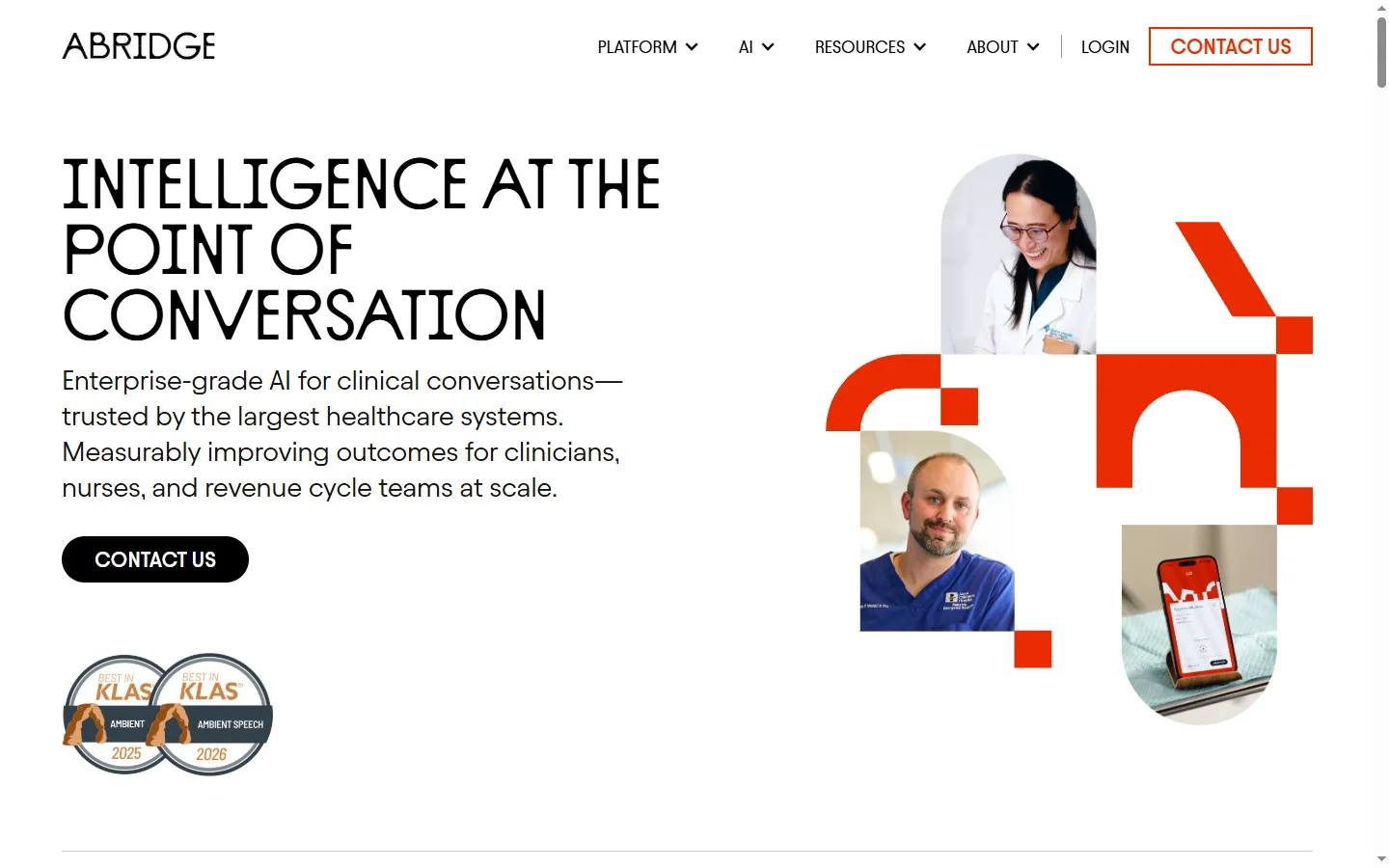
Abridge AI medical documentation platform that records and summarizes clinical conversations into structured physician notes in real time.

Air AI
Air AI conducts autonomous full-length AI phone calls for sales prospecting, appointment setting, and customer service without human agents.