
Omni AI
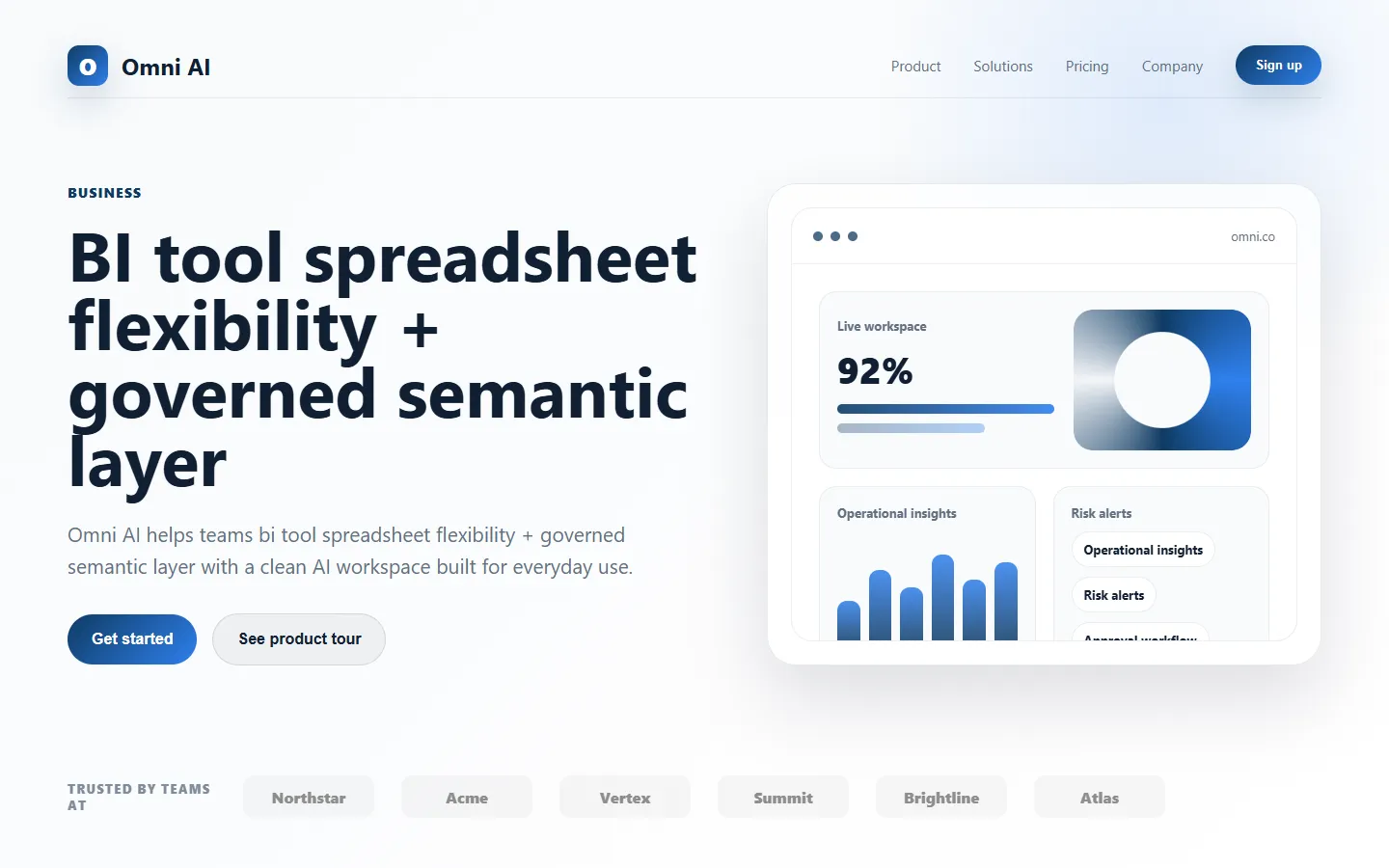
Paid ✓ Verified 🔥 TrendingOmni AI is a business intelligence and data analytics platform that combines spreadsheet flexibility with a governed semantic layer and AI-assisted querying for modern data teams.
📋 About Omni AI
Omni AI is a modern business intelligence platform that blends the flexibility of spreadsheets with the governance of a semantic layer, all enhanced by AI-assisted querying for data exploration. The omni ai platform is designed around a core insight — that analysts want the freedom to explore data the way they do in spreadsheets, while data teams need a centralized model that ensures consistency across the organization. Omni combines both by letting users start with exploratory queries and then promote trusted logic back into a shared semantic model that everyone builds on.
Built by the founders of Looker alongside veterans from Stitch and Cartographer, Omni brings a data-practitioner-first perspective to BI. The ai business intelligence platform connects to modern cloud data warehouses like Snowflake, BigQuery, Redshift, and Databricks, and lets teams build dashboards, ad-hoc analyses, and embedded analytics from a unified foundation. AI assistance helps analysts write SQL, translate natural-language questions into queries, and surface insights across large datasets faster than traditional BI tools allow.
Omni serves data and analytics teams at mid-market and enterprise companies that have outgrown simpler BI tools but find legacy platforms like Tableau and Looker either too rigid or too slow to evolve. Typical customers include fast-growing SaaS companies, e-commerce brands, and data-forward enterprises where both business users and analysts need to work together in a shared environment. For organizations investing in a modern data stack, Omni represents one of the most compelling new entrants in the business intelligence space.
⚡ Key Features of Omni AI
Hybrid Exploration and Semantic Model
Omni uniquely combines spreadsheet-like exploratory freedom with a governed semantic layer, so analysts can move fluidly between ad-hoc questions and shared models. The omni ai platform lets users start with free-form queries and then promote useful logic into the shared semantic model for the whole team. This closes the gap between messy analyst freedom and rigid enterprise BI governance.
AI Query Generation
Ask questions in natural language and Omni translates them into SQL against the semantic model, returning results alongside the generated query for transparency. The ai business intelligence layer accelerates exploration for both analysts and business users without hiding what the system is actually doing. Users can learn and edit the underlying SQL rather than being stuck with black-box answers.
Modern Cloud Data Warehouse Integration
Omni connects natively to Snowflake, BigQuery, Redshift, Databricks, and other modern cloud warehouses, pushing computation down to the warehouse rather than extracting data to a separate engine. This preserves security, governance, and performance characteristics that data teams already manage in their warehouse. No data movement means lower costs and simpler compliance.
Dashboards and Ad-Hoc Analysis
Build interactive dashboards, ad-hoc analyses, and embedded analytics on a single unified foundation. Analysts can iterate between dashboard creation and open-ended exploration without switching tools. Business users interact with dashboards through rich filtering and drill-down capabilities that match or exceed legacy BI platforms.
Embedded Analytics
Omni supports embedding dashboards, charts, and self-service analytics inside external applications through APIs, iframes, and SDKs. SaaS companies embed Omni to give their own customers analytics capabilities without building a BI stack from scratch. White-labeling options let the embedded experience match the host product's brand.
Version Control and Change Management
Semantic model changes, dashboard updates, and content organization are managed with Git-style version control so teams can review, revert, and collaborate on BI content the way engineers manage code. This brings software engineering discipline to analytics, improving reliability and reducing the mystery of who changed what and when.
Built by BI Veterans
Omni's team includes founders and engineers from Looker, Stitch, and Cartographer, bringing decades of experience building modern data platforms. This shows in design choices that address real pain points longtime BI users recognize — query iteration speed, model evolution, and cross-team collaboration. Customers report that the platform feels like BI designed by practitioners who actually use BI.
🎯 Use Cases for Omni AI
⚖️ Omni AI Pros & Cons
Advantages
- ✓Unique combination of spreadsheet-style flexibility and semantic governance
- ✓AI-assisted SQL generation with full transparency
- ✓Native integration with modern cloud data warehouses
- ✓Git-style version control for BI artifacts
- ✓Built by veterans who understand real BI workflows
Drawbacks
- ✗Newer platform with smaller ecosystem than established BI tools
- ✗Requires an existing modern cloud data warehouse
- ✗Semantic modeling has a learning curve for new users
- ✗Enterprise pricing not suitable for very small teams
📖 How to Use Omni AI
Visit omni.co and sign up for a free trial or request a demo to evaluate the platform.
Connect Omni to your existing cloud data warehouse (Snowflake, BigQuery, Redshift, Databricks).
Build an initial semantic model that captures your core business metrics and dimensions.
Explore data through natural-language questions, SQL, or point-and-click query building.
Create dashboards and ad-hoc analyses that business users can consume or remix.
Promote useful ad-hoc logic into the shared semantic model so the whole team benefits.
❓ Omni AI FAQ
Omni AI is a modern business intelligence platform that combines spreadsheet-style flexibility with a governed semantic layer, enhanced by AI-assisted querying. It is built for data and analytics teams at mid-market and enterprise companies using modern cloud data warehouses.
Omni connects natively to Snowflake, BigQuery, Redshift, Databricks, and other modern cloud warehouses. Queries are pushed down to the warehouse rather than extracting data to a separate engine.
Omni combines Looker's semantic modeling with Tableau's exploratory flexibility in a single environment, and adds modern features like AI-assisted querying and Git-style version control. Many customers migrate from legacy BI tools to Omni for better user experience and lower TCO.
Yes. The omni ai platform includes natural-language querying that translates user questions into SQL against the semantic model. The generated SQL is shown transparently so users can learn, edit, and audit the AI's output.
Omni is priced per user with custom quotes based on team size, usage, and modules used. Pricing is negotiated during the sales process and a free trial is available to evaluate the platform.
Related to Omni AI

A2E AI
A2E AI productivity platform converts audio and video recordings into transcripts, summaries, and action items with speaker identification.

Abnormal AI
Abnormal AI uses behavioral AI to detect business email compromise, account takeover, and socially engineered phishing that bypasses secure email gateways.

Abridge AI
Abridge AI medical documentation platform that records and summarizes clinical conversations into structured physician notes in real time.

Accrete AI
Accrete AI builds autonomous enterprise AI agents for defense, government, and commercial intelligence workflows.

ChatGPT
ChatGPT AI assistant by OpenAI for writing, coding, research, image analysis, and everyday problem-solving.

Claude
Claude AI assistant by Anthropic with a 200K context window, strong reasoning, and safety-focused design for writing, coding, and analysis.
Featured on WhatIf.ai
Add this badge to your website to show you're listed on WhatIf AI
Alternatives to Omni AI

A2E AI
A2E AI productivity platform converts audio and video recordings into transcripts, summaries, and action items with speaker identification.
Abnormal AI
Abnormal AI uses behavioral AI to detect business email compromise, account takeover, and socially engineered phishing that bypasses secure email gateways.

Abridge AI
Abridge AI medical documentation platform that records and summarizes clinical conversations into structured physician notes in real time.

Air AI
Air AI conducts autonomous full-length AI phone calls for sales prospecting, appointment setting, and customer service without human agents.