
Jorie AI
Paid ✓ VerifiedJorie AI is a healthcare revenue cycle management platform that uses AI agents to automate claims, prior authorizations, and patient billing workflows.
📋 About Jorie AI
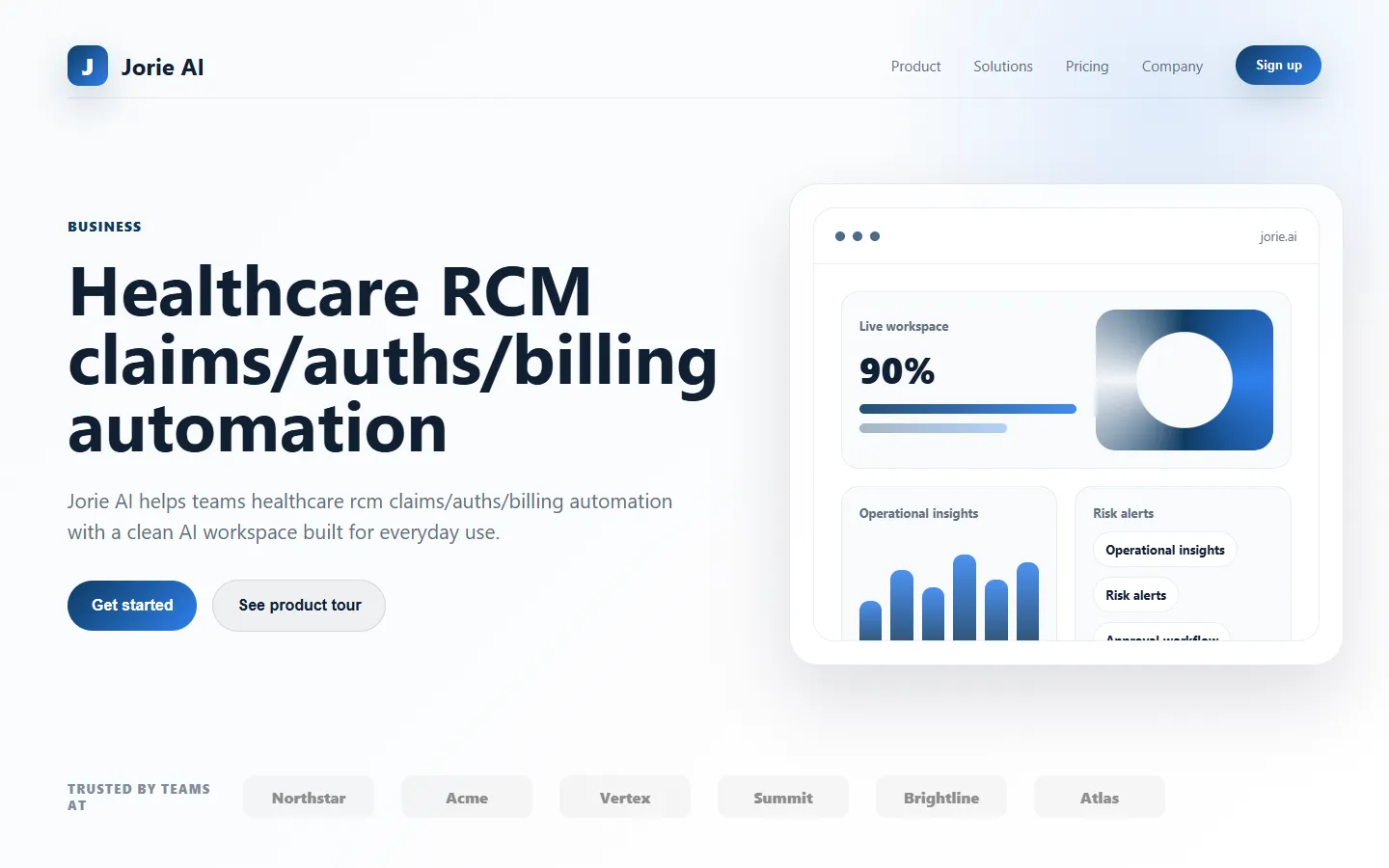
Jorie AI is a healthcare revenue cycle management platform that deploys purpose-built AI agents to automate the repetitive, rule-heavy workflows that drain hospital and physician practice staff time. The system handles claim submission, denial management, prior authorization, eligibility verification, and patient billing conversations using a combination of large language models, RPA, and healthcare-specific knowledge graphs. Unlike generic enterprise AI, Jorie is trained on CPT, ICD-10, HCPCS, and payer-specific rules so its agents can reason about medical billing with high accuracy.
The platform integrates with major electronic health record and practice management systems including Epic, Cerner, Athenahealth, and NextGen, so deployments do not require replacing existing infrastructure. Dashboards give revenue cycle leaders visibility into agent throughput, denial causes, and net collections impact, while audit logs preserve every action for compliance. Jorie's agents escalate edge cases to human operators with full context, which keeps accuracy high while maximizing automation.
Jorie AI serves hospitals, physician groups, and RCM service providers that want to reduce billing staff costs and recover revenue lost to slow claim work and unmanaged denials. Customers typically report double-digit percentage improvements in clean claim rates and faster days-in-accounts-receivable after deployment. The platform is HIPAA compliant with SOC 2 Type II certification.
⚡ Key Features of Jorie AI
Claims Submission Agent
Jorie's claims submission agent reads charges from the practice management system, validates against payer-specific edits, and submits clean claims through the clearinghouse without manual review. It learns from historical denials to proactively flag and correct issues before submission. Customers typically see clean claim rates rise above 95 percent after a few weeks of tuning.
Denial Management Agent
When a claim denies, the agent parses the EOB or 835 file, categorizes the denial reason, and routes it through an automated workflow that includes rebilling, appeal letter generation, and payer portal submission. The agent handles the vast majority of low-complexity denials end-to-end and escalates complex appeals to a human biller with a draft response. This recovers revenue that practices typically write off due to staff capacity limits.
Prior Authorization Automation
The prior authorization agent pulls clinical documentation from the EHR, completes payer-specific PA forms, submits them through portals or fax, and tracks approval status. It uses LLMs to extract relevant clinical justification from chart notes rather than relying on rigid templates. This reduces PA turnaround from days to hours for many service lines.
Eligibility and Benefits Verification
Before appointments, the agent runs real-time eligibility checks, surfaces copay and deductible information, and writes results back to the scheduling system. Patients arrive with accurate financial expectations, and front-desk staff spend less time on the phone with payers. Verification runs on a schedule and re-checks the day-of-service to catch plan changes.
Patient Billing Conversations
A voice and chat agent handles routine inbound patient billing questions, payment plan setup, and balance notifications in English and Spanish. The agent can process card payments through the integrated payment gateway and escalate disputes to human staff with full conversation transcripts. This frees patient accounts teams to focus on high-value accounts.
EHR and PM Integrations
Jorie connects to Epic, Cerner, Athenahealth, NextGen, eClinicalWorks, and most major EHR and practice management systems through certified APIs or HL7 interfaces. Deployments do not require ripping and replacing existing systems, and data stays inside the customer's technology environment where possible. Integration typically completes within 6 to 10 weeks.
Compliance and Audit Trail
Every agent action is logged with user-equivalent attribution, timestamps, and before-and-after snapshots to support HIPAA audit and payer review requirements. Role-based access controls, PHI encryption at rest and in transit, and SOC 2 Type II certification meet healthcare security expectations. Customers retain full audit export capability.
🎯 Use Cases for Jorie AI
⚖️ Jorie AI Pros & Cons
Advantages
- ✓Purpose-built for healthcare RCM with payer rule knowledge
- ✓End-to-end automation across claims, denials, and PA
- ✓Integrates with major EHR and practice management systems
- ✓HIPAA compliant with SOC 2 Type II certification
- ✓Measurable ROI through clean claim rate and denial recovery
Drawbacks
- ✗Enterprise pricing inaccessible to small practices
- ✗Implementation takes 6 to 10 weeks
- ✗Requires clean historical data for best agent performance
- ✗Limited to US healthcare billing context
📖 How to Use Jorie AI
Request a discovery call at jorie.ai to scope your RCM pain points and integration environment.
Work with Jorie's implementation team to connect your EHR or practice management system through API or HL7.
Configure payer rule sets, fee schedules, and denial workflows with Jorie's healthcare engineers.
Pilot one agent such as claims submission or denial management on a sample patient population.
Review agent accuracy in the dashboard and approve expansion to additional service lines.
Scale across the full RCM workflow and monitor financial KPIs in the executive dashboard.
❓ Jorie AI FAQ
Yes. Jorie AI is HIPAA compliant, signs Business Associate Agreements with all customers, and holds SOC 2 Type II certification. PHI is encrypted in transit and at rest.
Jorie integrates with Epic, Cerner, Athenahealth, NextGen, eClinicalWorks, and most major EHR and practice management systems through certified APIs or HL7 feeds.
Most customers do not lay off billing staff. Instead Jorie handles routine volume so existing staff can focus on complex appeals, contract management, and patient-facing work that requires human judgment.
Typical implementations run 6 to 10 weeks depending on EHR complexity, payer mix, and the number of agents being deployed. Pilot-to-production for a single agent is usually faster.
Pricing is customized and typically based on transaction volume or percentage of collections. Contact Jorie's sales team for a quote based on your organization's size.
Related to Jorie AI

A2E AI
A2E AI productivity platform converts audio and video recordings into transcripts, summaries, and action items with speaker identification.

Abnormal AI
Abnormal AI uses behavioral AI to detect business email compromise, account takeover, and socially engineered phishing that bypasses secure email gateways.

Abridge AI
Abridge AI medical documentation platform that records and summarizes clinical conversations into structured physician notes in real time.

Accrete AI
Accrete AI builds autonomous enterprise AI agents for defense, government, and commercial intelligence workflows.
Featured on WhatIf.ai
Add this badge to your website to show you're listed on WhatIf AI
Alternatives to Jorie AI

A2E AI
A2E AI productivity platform converts audio and video recordings into transcripts, summaries, and action items with speaker identification.

Abnormal AI
Abnormal AI uses behavioral AI to detect business email compromise, account takeover, and socially engineered phishing that bypasses secure email gateways.

Abridge AI
Abridge AI medical documentation platform that records and summarizes clinical conversations into structured physician notes in real time.

Air AI
Air AI conducts autonomous full-length AI phone calls for sales prospecting, appointment setting, and customer service without human agents.