
Hume AI
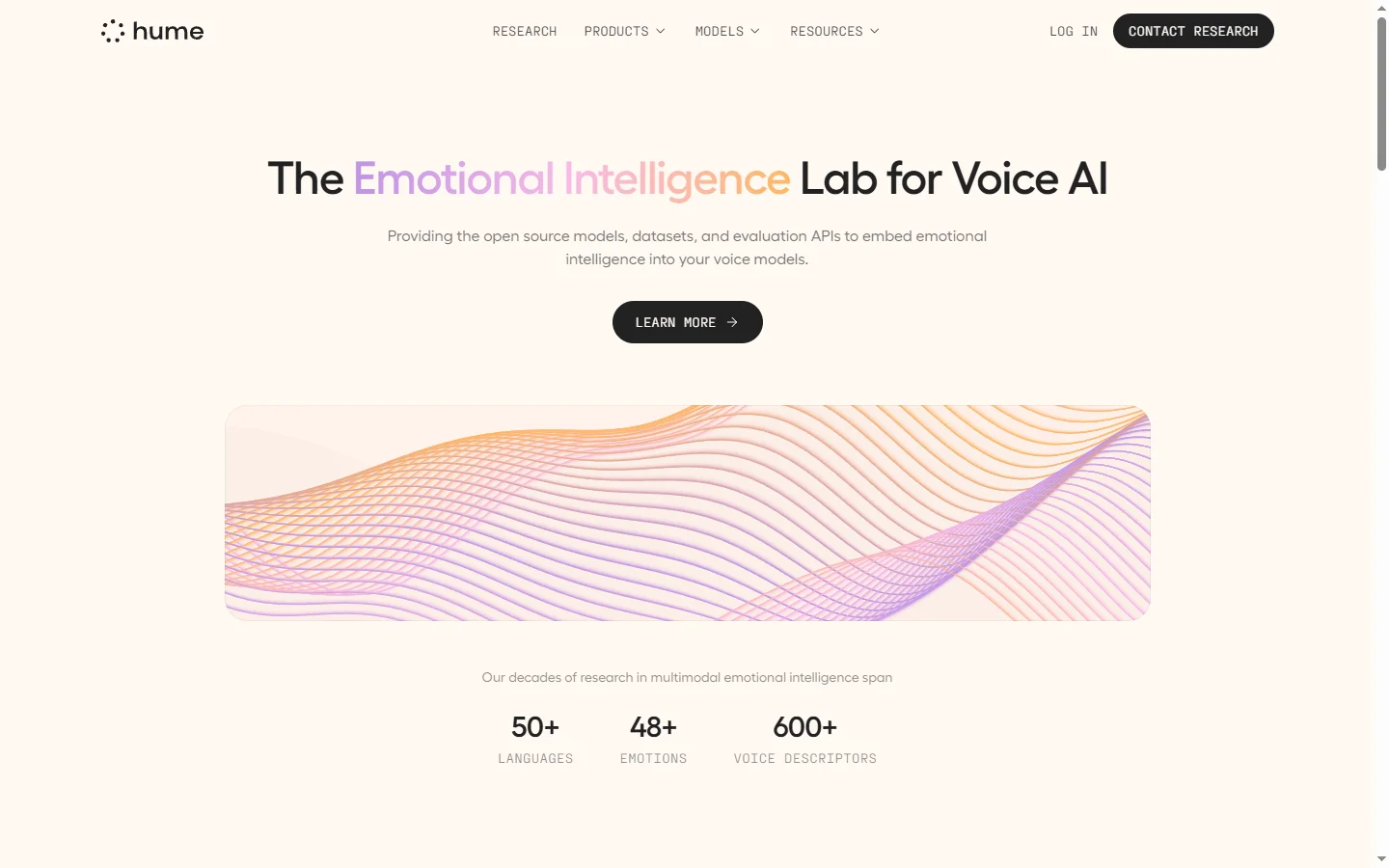
Freemium ✓ Verified 🔥 TrendingHume AI builds emotionally intelligent voice AI, featuring the Empathic Voice Interface (EVI) that reads tone, prosody, and sentiment in real time.
📋 About Hume AI
Hume AI is a research-driven voice AI platform that builds emotionally intelligent conversational systems. Its flagship product, the Empathic Voice Interface (EVI), is a speech-to-speech model that understands not just the words a user says but the emotional tone, prosody, and intent behind them. EVI generates voice replies that adapt to the user's mood, making interactions feel more natural than typical text-to-speech assistants. Hume's models are grounded in over a decade of academic research on facial expression, vocal burst, and speech prosody.
Developers integrate Hume AI through a real-time WebSocket API, REST endpoints, and SDKs for JavaScript, Python, and React. The platform exposes detailed emotional measurement data — including expression scores, vocal burst classification, and language sentiment — which can be used to power customer support agents, mental health companions, character voices in games, and accessibility tools. EVI 2 supports interruption, turn-taking, and multilingual conversation, with response latency tuned for live phone-style interactions. Hume operates under a published ethical guidelines framework reviewed by The Hume Initiative.
Hume AI serves product teams, indie developers, healthcare innovators, and researchers who need voice interfaces that go beyond transactional speech recognition. Free credits cover prototyping, with usage-based pricing for production workloads. The platform is particularly popular for building empathic chatbots, voice-first mobile apps, NPCs in interactive media, and clinical conversation analysis tools where understanding emotional state is core to the user experience.
⚡ Key Features of Hume AI
Empathic Voice Interface (EVI)
EVI is Hume AI's speech-to-speech foundation model that listens to user audio, infers emotional context from prosody and word choice, and responds with a voice that mirrors appropriate affect. Unlike pipelines that chain separate STT, LLM, and TTS components, EVI processes voice end-to-end, which dramatically cuts latency and preserves emotional nuance. Developers can configure persona, voice timbre, and conversation rules through the EVI dashboard. The interface supports barge-in, turn-taking, and contextual memory within a session.
Emotional Measurement Models
Hume exposes three dedicated models that score input for 48 distinct expressions across face, voice, and language. The vocal burst model classifies non-speech sounds like laughs, sighs, and gasps, while the prosody model rates emotional tone within speech. Product teams use these scores to route customer service calls, detect frustrated users in real time, or trigger empathy-aware responses in chatbots. All measurement endpoints return granular numerical confidence values for downstream logic.
Real-Time WebSocket Streaming
The hume ai streaming API delivers expression and prosody scores frame by frame as audio is captured, enabling live emotional feedback loops in apps and games. Response latency typically falls under 200 ms for EVI voice replies, which is fast enough for natural turn-taking on phone calls or web sessions. SDKs for browser, Node.js, Python, and Swift handle reconnects, audio resampling, and authentication so developers can focus on application logic.
Multilingual EVI 2
EVI 2 supports English, Spanish, German, French, Portuguese, Italian, and several additional languages with native-sounding voices and cross-language prosody understanding. The model can switch language mid-conversation when prompted, which is useful for travel assistants, international support agents, and language tutoring apps. Each language preserves emotional sensitivity rather than degrading to neutral TTS, a common weakness in multilingual voice products.
Custom Voices and Personas
Developers can craft persona prompts, system instructions, and voice characteristics (pitch, warmth, pacing) for their EVI deployment without retraining the model. This makes it practical to ship branded voice agents — a calm wellness coach, an energetic game NPC, or a measured financial advisor — from the same underlying foundation. Custom voices can be saved and assigned to different applications within a Hume workspace.
Ethics-First Research Foundation
Hume AI is governed by The Hume Initiative, an external nonprofit that publishes guidelines on consent, fairness, and prohibited uses for empathic AI. Use cases like emotional manipulation in advertising or deception in dating apps are explicitly disallowed under the terms of service. This framework appeals to regulated industries — healthcare, education, and accessibility — where ethical deployment of emotion AI matters to procurement and compliance teams.
Developer Playground and Dashboard
The Hume dashboard provides a no-code playground for testing EVI configurations, browsing emotion measurement results, and inspecting WebSocket payloads before writing integration code. Teams can share configuration links internally, monitor usage and cost, and roll back to previous prompt versions. API key management and per-project usage caps help enterprises control spend during pilot phases.
🎯 Use Cases for Hume AI
⚖️ Hume AI Pros & Cons
Advantages
- ✓Industry-leading emotional intelligence and prosody understanding
- ✓Low-latency speech-to-speech architecture with EVI
- ✓Multilingual support across major European and American languages
- ✓Strong ethical framework via The Hume Initiative
- ✓Generous free developer credits for prototyping
Drawbacks
- ✗Usage-based pricing can scale quickly for high-volume production apps
- ✗Smaller voice library than commercial TTS providers like ElevenLabs
- ✗Requires technical integration through SDK or API, no end-user app
📖 How to Use Hume AI
Sign up at hume.ai and verify your developer account to receive starter API credits.
Open the Hume dashboard and create a new EVI configuration with a system prompt, persona, and voice selection.
Generate an API key and download the SDK for your platform (JavaScript, Python, Swift, or React Native).
Connect to the EVI WebSocket endpoint, stream microphone audio, and play back the returned voice frames in your app.
Use the Expression Measurement API on stored audio or video files to extract emotion scores for analytics or routing.
Monitor usage and refine the system prompt in the playground based on real conversation transcripts.
❓ Hume AI FAQ
EVI is a speech-to-speech foundation model from Hume AI that understands emotional tone in user speech and replies with a voice that adapts to the situation. It handles transcription, language understanding, and voice generation in a single end-to-end model for low-latency natural conversation.
Hume AI offers free starter credits for new developer accounts, which is enough to build and test integrations. Beyond the free tier, pricing is usage-based per minute of EVI conversation or per file analyzed by the measurement APIs.
EVI 2 supports English, Spanish, German, French, Portuguese, Italian, and additional European and Asian languages with native voices and cross-language emotional understanding.
Yes, but Hume AI deployments in clinical contexts must follow The Hume Initiative ethical guidelines and applicable healthcare regulations such as HIPAA. Several research and digital health teams use Hume's measurement APIs for screening and study analysis.
Hume AI is focused specifically on emotional intelligence and empathic interaction, while ElevenLabs prioritizes voice cloning and TTS quality and OpenAI voice is a general-purpose conversational model. For apps where reading and responding to user emotion is core, Hume AI is the most specialized choice.
Related to Hume AI

Featured on WhatIf.ai
Add this badge to your website to show you're listed on WhatIf AI
Alternatives to Hume AI

Adobe Podcast AI
Adobe Podcast AI enhances spoken audio recordings by removing background noise and improving voice clarity to broadcast-quality standards.

Base44 AI
Base44 AI is an AI app builder and website builder that generates full-stack web applications from natural language descriptions with backend, database, and UI included.

Browse AI
Browse AI is a no-code web scraping and monitoring tool that extracts structured data from any website and tracks changes over time without writing code.


Cantina AI
Cantina AI is a freemium platform for building and deploying full-stack web applications using AI-assisted development with live preview and one-click deployment.