
ChainWizard AI
Freemium ✓ Verified 🔥 TrendingChainWizard AI is a no-code workflow builder for chaining LLM calls, data sources, and business logic into production AI pipelines.
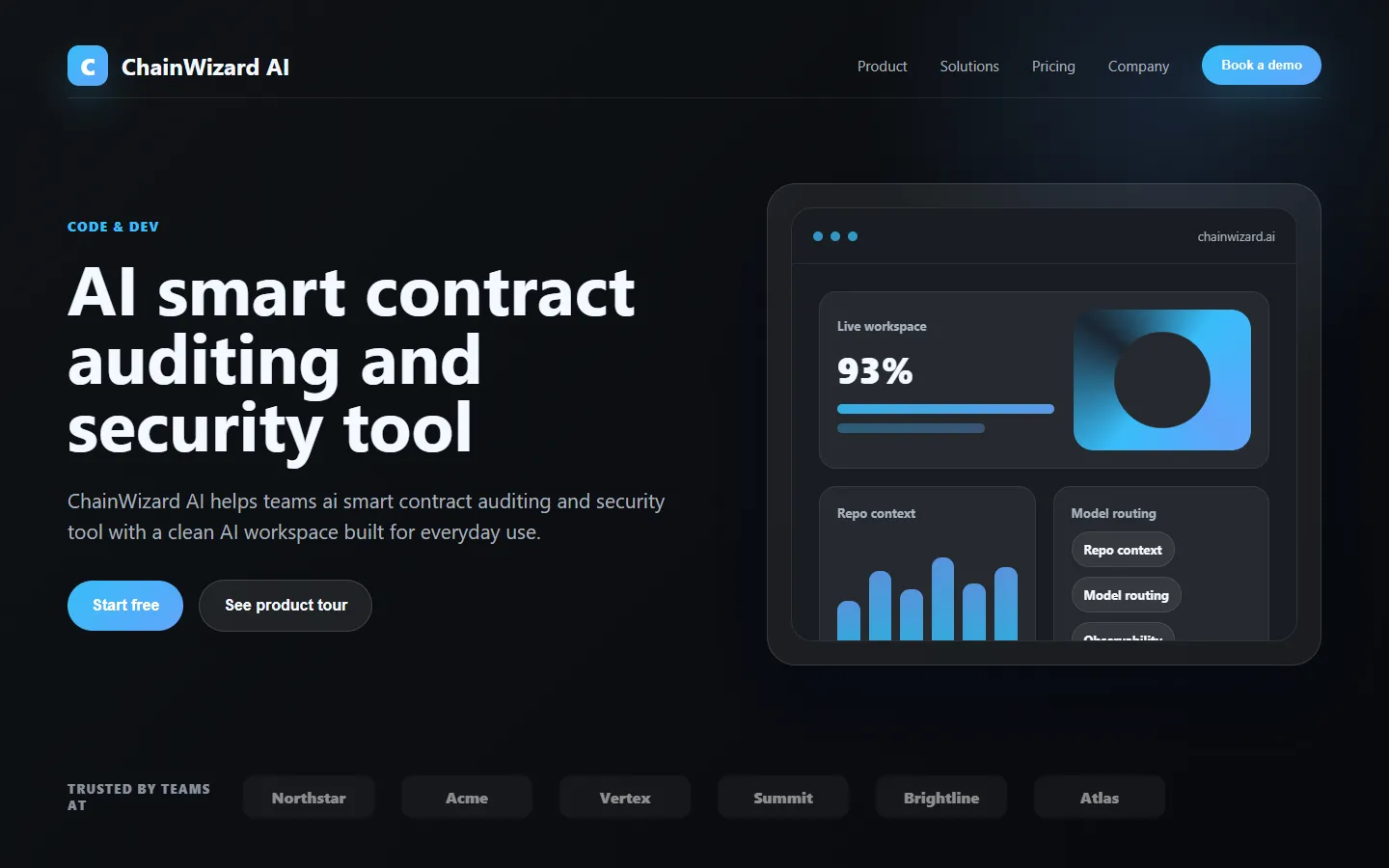
📋 About ChainWizard AI
ChainWizard AI is a visual workflow platform that lets teams build, test, and deploy multi-step AI pipelines without writing orchestration code. Users drag LLM nodes, data connectors, conditional logic, and tool calls onto a canvas and connect them to form chains that handle real business tasks — from customer support triage to document processing to research automation.
The ChainWizard AI platform supports leading foundation models including GPT, Claude, Gemini, and open-source alternatives, so teams can route each step to the most cost-effective model. Built-in evaluators, prompt versioning, and observability dashboards make it straightforward to compare variants, catch regressions, and understand exactly why a chain produced a given output. Human-in-the-loop nodes let operators review or correct intermediate results before the pipeline continues.
ChainWizard AI serves product teams, operations teams, and growing AI-native startups who need to go from prototype to production without hiring a dedicated MLOps function. Customers use it to automate repetitive knowledge work, build internal copilots, and ship customer-facing AI features behind feature flags. Because workflows run on managed infrastructure, deployments scale horizontally without custom DevOps work.
⚡ Key Features of ChainWizard AI
Visual Chain Builder
Drag-and-drop canvas for connecting LLM nodes, data sources, conditional branches, and tool calls into end-to-end workflows. Non-engineers can design complex chains without writing code, while engineers can drop into a code node when custom logic is needed. This hybrid approach means product managers and developers can collaborate on the same workflow.
Multi-Model Routing
Route each step of a chain to the most appropriate model — GPT for reasoning, Claude for long context, Gemini for multimodal, or open-source models for cost-sensitive steps. ChainWizard AI abstracts provider APIs behind a single interface and lets teams switch models without rewriting prompts. Cost and latency comparisons are visible inline during design.
Prompt Versioning and A/B Testing
Every prompt change is tracked, and teams can run A/B tests across variants with production traffic to measure which performs best. Built-in evaluators score outputs on quality dimensions the team defines. This removes the guesswork typical of prompt engineering and creates a paper trail for compliance.
Observability and Tracing
Every chain execution produces a detailed trace showing every model call, tool invocation, token count, and latency measurement. Engineers can debug failures by replaying any run and inspecting intermediate state. Dashboards aggregate cost, latency, and quality metrics across workflows for capacity planning.
Human-in-the-Loop Review
Insert approval steps where a human reviews or edits intermediate results before the chain proceeds. This is valuable for high-stakes automations like legal drafting or customer communication where full autonomy is not acceptable. Reviewers get a simple web UI with diff views and one-click approve or reject actions.
Pre-Built Integrations
Native connectors for Salesforce, HubSpot, Slack, Notion, Google Workspace, Airtable, and dozens of other SaaS tools let ChainWizard AI read from and write to the systems your team already uses. Webhooks and a generic HTTP node cover anything else. These integrations turn the platform into a genuine automation layer rather than a sandbox.
Managed Deployment and Scaling
Published chains run on ChainWizard AI's managed infrastructure with automatic scaling, retries, and rate limiting. Teams expose chains as API endpoints or trigger them from schedules, webhooks, or incoming emails. This removes the need to maintain custom serving infrastructure for AI features.
🎯 Use Cases for ChainWizard AI
⚖️ ChainWizard AI Pros & Cons
Advantages
- ✓Visual builder accessible to non-engineers
- ✓Multi-model support avoids vendor lock-in
- ✓Strong observability and prompt versioning
- ✓Managed infrastructure removes DevOps burden
- ✓Free tier suitable for prototypes and small workflows
Drawbacks
- ✗Complex custom logic still requires code nodes
- ✗Per-run pricing can grow quickly at scale
- ✗Advanced features gated to higher tiers
- ✗Learning curve for teams new to LLM orchestration
📖 How to Use ChainWizard AI
Sign up at chainwizard.ai with email or Google SSO to start on the free tier.
Pick a template — support triage, document extraction, or research assistant — or start from a blank canvas.
Drag model nodes, data connectors, and logic blocks onto the canvas and wire them together.
Test runs inline with sample inputs and inspect the trace to refine prompts and logic.
Publish the chain as an API endpoint, schedule, or webhook trigger so other systems can invoke it.
Monitor production runs from the dashboard and iterate on prompt versions using A/B testing.
❓ ChainWizard AI FAQ
ChainWizard AI is a visual workflow platform for building, testing, and deploying multi-step AI pipelines that combine LLMs with tools, data sources, and business logic.
ChainWizard AI supports GPT, Claude, Gemini, Mistral, and major open-source models. Each node in a chain can route to a different model, so teams can balance cost, latency, and quality.
Yes. ChainWizard AI offers a free tier with a monthly allowance of chain runs and core features. Paid plans unlock higher limits, team collaboration, and advanced observability.
Yes. The visual builder is designed for product managers, operations leads, and analysts to author workflows without writing code, while engineers can drop into custom code nodes when needed.
Customer data is not used to train models, and enterprise plans offer SSO, role-based access, audit logs, and private model deployment options to meet compliance requirements.
Related to ChainWizard AI

A2E AI
A2E AI productivity platform converts audio and video recordings into transcripts, summaries, and action items with speaker identification.

Abnormal AI
Abnormal AI uses behavioral AI to detect business email compromise, account takeover, and socially engineered phishing that bypasses secure email gateways.

Abridge AI
Abridge AI medical documentation platform that records and summarizes clinical conversations into structured physician notes in real time.

Accrete AI
Accrete AI builds autonomous enterprise AI agents for defense, government, and commercial intelligence workflows.

ChatGPT
ChatGPT AI assistant by OpenAI for writing, coding, research, image analysis, and everyday problem-solving.

Claude
Claude AI assistant by Anthropic with a 200K context window, strong reasoning, and safety-focused design for writing, coding, and analysis.
Featured on WhatIf.ai
Add this badge to your website to show you're listed on WhatIf AI
Alternatives to ChainWizard AI

A2E AI
A2E AI productivity platform converts audio and video recordings into transcripts, summaries, and action items with speaker identification.
Abnormal AI
Abnormal AI uses behavioral AI to detect business email compromise, account takeover, and socially engineered phishing that bypasses secure email gateways.

Abridge AI
Abridge AI medical documentation platform that records and summarizes clinical conversations into structured physician notes in real time.


Air AI
Air AI conducts autonomous full-length AI phone calls for sales prospecting, appointment setting, and customer service without human agents.