
Cascade AI
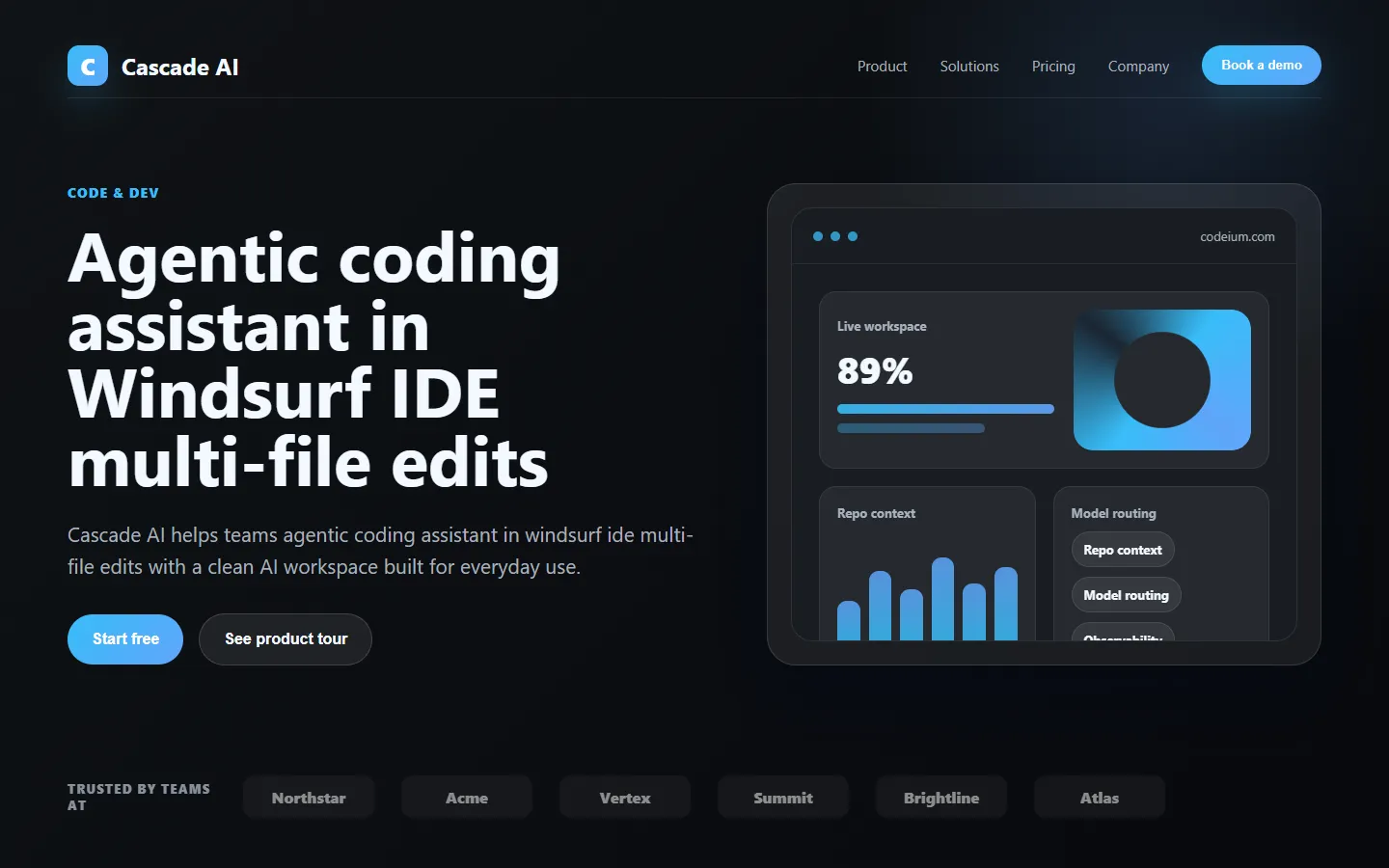
Freemium ✓ Verified 🔥 TrendingCascade AI is an agentic coding assistant built into the Windsurf IDE that plans, edits, and tests code across multi-file projects autonomously.
📋 About Cascade AI
Cascade AI is the agentic coding experience inside the Windsurf IDE (formerly Codeium), designed to go beyond single-line completion and act as a pair-programmer that reasons across an entire repository. Rather than editing one file at a time, Cascade maintains awareness of the project, plans the changes required to implement a feature or fix a bug, executes edits across multiple files, runs terminal commands, and verifies the result. Developers interact with it in natural language while retaining a diff-based review step before any change is committed.
The system combines a deep indexer that models imports, type graphs, and runtime behavior with a planning loop that decomposes larger asks into concrete steps. It can open files, read and modify them, run tests, inspect error output, and iterate without asking for permission on every keystroke while still respecting review boundaries. Cascade works with TypeScript, Python, Go, Rust, Java, and other major languages, and supports both local and cloud development environments. Team-level features add shared memory, style rules, and visibility for engineering managers.
Cascade AI targets professional developers and engineering teams who want autonomy above what traditional inline autocomplete offers but without surrendering control over their codebase. Use cases include shipping end-to-end features, large-scale refactors, migration work, test coverage expansion, and onboarding engineers to unfamiliar codebases. Pricing includes a generous free tier of Cascade actions and paid tiers that unlock higher limits, premium models, and enterprise controls.
⚡ Key Features of Cascade AI
Repository-Aware Agentic Editing
Cascade maintains an understanding of the full project graph — imports, type relationships, and runtime dependencies — so a request to add a feature touches all the right files, not just the one currently open. Instead of generating snippets that developers must splice in, Cascade applies coordinated edits across modules. This is particularly powerful for API changes, schema migrations, and refactors where partial edits would break the build.
Plan, Edit, Run, Verify Loop
For larger tasks, Cascade builds a plan before editing, executes changes step by step, runs terminal commands and tests, reads output, and iterates when something fails. This mimics how a senior engineer actually works rather than stopping at the first output. Developers see a transcript of reasoning and actions so they can intervene when needed.
Inline Diff Review
Every change Cascade proposes appears as a reviewable diff inside Windsurf before being applied, so developers can accept, reject, or edit hunks at the granularity of individual changes. This preserves the control that inline autocomplete provides while unlocking autonomy on larger tasks. Teams retain existing code review discipline on top of normal pull request workflows.
Terminal and Tool Execution
Cascade can execute commands in the integrated terminal — installing dependencies, running build scripts, invoking test suites — and read the resulting output. This closes the loop on tasks that require running the code rather than just writing it. Developers see each command before it runs and can cancel at any time.
Context Memory and Rules
Teams can define workspace rules (coding style, architectural patterns, preferred libraries) that Cascade follows across all sessions, reducing the need to restate conventions in every prompt. Project memory persists across conversations so context does not need to be rebuilt on each task. Rules can be shared across team members for consistency.
Model Choice
Cascade supports multiple frontier models including Claude, GPT, and others, letting developers pick based on task fit — reasoning-heavy refactors, quick completions, or cost-sensitive batch work. Model selection can be adjusted per request without changing integrations. This provides flexibility as new and better models become available.
🎯 Use Cases for Cascade AI
⚖️ Cascade AI Pros & Cons
Advantages
- ✓Edits coordinated changes across many files, not just single snippets
- ✓Plan-edit-run-verify loop mimics senior engineering workflow
- ✓Every change is reviewable as a diff before being applied
- ✓Supports multiple frontier models interchangeably
- ✓Generous free tier of Cascade actions for individual developers
Drawbacks
- ✗Requires switching to or using the Windsurf IDE
- ✗Agent loops can consume tokens quickly on large tasks
- ✗Quality depends on how well the repo is structured
- ✗Autonomy may produce unexpected edits without careful review
📖 How to Use Cascade AI
Download and install Windsurf from codeium.com — Cascade is built into the IDE.
Sign in with a Codeium account — the free tier includes a number of Cascade actions per month.
Open your project in Windsurf and let Cascade index the repository the first time.
Open the Cascade panel and describe the change you want in natural language.
Review the plan and diffs that Cascade proposes, accepting or editing hunks as needed.
Upgrade to Pro or Teams for higher action limits, premium models, and collaboration features.
❓ Cascade AI FAQ
Cascade AI is the agentic coding assistant built into the Windsurf IDE by Codeium. It plans and executes multi-file code changes, runs terminal commands, and iterates until a task is complete, rather than stopping at single-snippet suggestions.
Cascade runs inside the Windsurf IDE. Codeium also offers an inline autocomplete plugin for VS Code and JetBrains, but the full agentic Cascade experience is part of Windsurf specifically.
Cascade supports all major languages including TypeScript, JavaScript, Python, Go, Rust, Java, C#, PHP, Ruby, and more. Coverage is similar to other frontier coding assistants.
Yes. Codeium offers a free tier that includes a number of Cascade actions per month, with paid Pro and Teams plans for higher limits, premium models, and enterprise controls.
Cascade sends code snippets to the selected model provider to generate edits. Codeium offers enterprise plans with self-hosted or private-compute options for organizations that cannot send source code to third-party inference providers.
Related to Cascade AI

A2E AI
A2E AI productivity platform converts audio and video recordings into transcripts, summaries, and action items with speaker identification.

Abnormal AI
Abnormal AI uses behavioral AI to detect business email compromise, account takeover, and socially engineered phishing that bypasses secure email gateways.

Abridge AI
Abridge AI medical documentation platform that records and summarizes clinical conversations into structured physician notes in real time.

Accrete AI
Accrete AI builds autonomous enterprise AI agents for defense, government, and commercial intelligence workflows.

Cursor
Cursor ai code editor built on VS Code with AI-powered code generation, codebase chat, and multi-file editing.
Featured on WhatIf.ai
Add this badge to your website to show you're listed on WhatIf AI
Alternatives to Cascade AI

A2E AI
A2E AI productivity platform converts audio and video recordings into transcripts, summaries, and action items with speaker identification.

Abnormal AI
Abnormal AI uses behavioral AI to detect business email compromise, account takeover, and socially engineered phishing that bypasses secure email gateways.

Abridge AI
Abridge AI medical documentation platform that records and summarizes clinical conversations into structured physician notes in real time.

Air AI
Air AI conducts autonomous full-length AI phone calls for sales prospecting, appointment setting, and customer service without human agents.