
Bigfoot AI
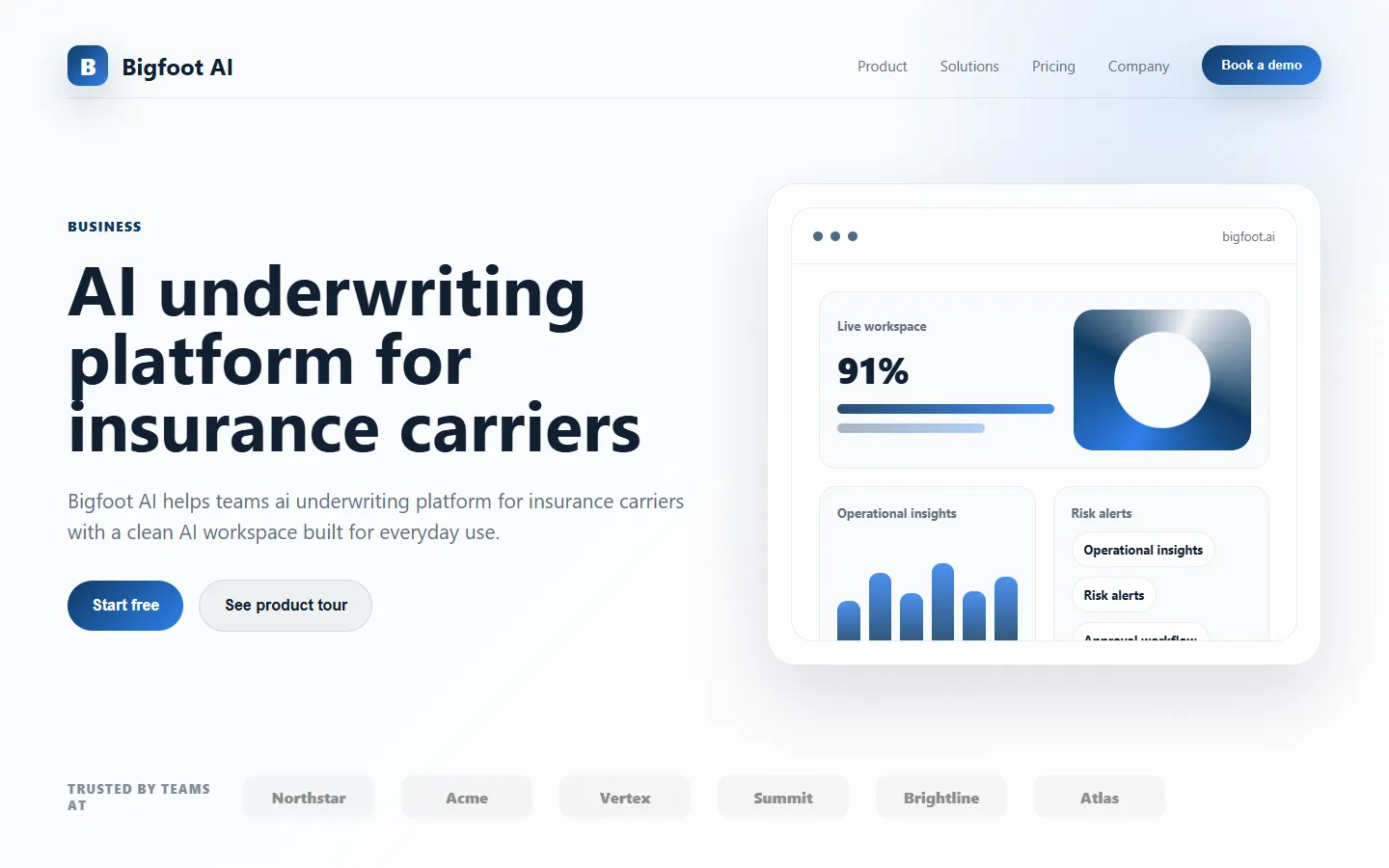
Paid ✓ VerifiedBigfoot AI is an enterprise AI platform that helps organizations operationalize large-scale data, machine learning, and generative AI workflows across analytics, search, and automation.
📋 About Bigfoot AI
Bigfoot AI is an enterprise AI platform designed to help data and analytics teams operationalize large-scale machine learning and generative AI workflows across their organizations. The bigfoot ai platform provides the foundational infrastructure — data integration, model orchestration, vector search, and deployment tooling — that enterprises need to move AI projects from experimentation to reliable production. Rather than forcing teams to stitch together a dozen disconnected tools, the platform consolidates the AI lifecycle into a single environment with enterprise-grade security and governance built in.
Bigfoot AI focuses specifically on the hard engineering problems that make enterprise AI deployment difficult: large-scale data pipelines, retrieval-augmented generation on proprietary knowledge, evaluation and monitoring of model quality over time, and cost-efficient inference at scale. The ai platform supports both structured and unstructured data, connects to common data warehouses and document stores, and integrates with both open-source and commercial foundation models. This lets enterprises adopt the best models for each task without being locked into a single vendor.
Bigfoot AI serves data-rich organizations in financial services, healthcare, retail, and technology that have meaningful amounts of proprietary data and compliance requirements. The platform is used by data engineering teams, ML platform teams, and business analysts working on use cases ranging from intelligent search across internal documents to automated decisioning in operations. For enterprises trying to move beyond AI pilots into production-grade systems, Bigfoot AI offers a pragmatic, integrated platform that reduces the engineering toil of enterprise AI deployment.
⚡ Key Features of Bigfoot AI
Unified AI Platform
Bigfoot AI consolidates data integration, model orchestration, retrieval, deployment, and monitoring into a single enterprise-grade platform. The bigfoot ai environment eliminates the typical patchwork of disconnected MLOps tools, reducing integration overhead and operational complexity. Data and ML teams work in one system rather than maintaining custom glue code across many.
Retrieval-Augmented Generation at Scale
The platform supports large-scale retrieval-augmented generation (RAG) with high-performance vector search, hybrid retrieval strategies, and evaluation tooling specifically designed for enterprise document corpora. Teams can connect proprietary data — contracts, tickets, research, policies — to foundation models without exposing sensitive content externally. RAG quality improves over time through built-in evaluation and feedback loops.
Multi-Model Orchestration
Bigfoot AI integrates with both open-source and commercial foundation models including OpenAI, Anthropic, Cohere, and self-hosted Llama-class models. Teams choose the right model for each task based on cost, quality, and compliance requirements rather than being locked into one vendor. The platform abstracts model differences so applications remain portable across providers.
Data Integration and Pipelines
Pre-built connectors link to common data warehouses (Snowflake, BigQuery, Redshift), document stores (S3, SharePoint, Confluence), and operational systems (Salesforce, Jira, Zendesk). Data engineers build and schedule pipelines that keep AI-ready indexes fresh as underlying sources change. This eliminates much of the custom ETL work that typically slows enterprise AI projects.
Model Evaluation and Monitoring
The platform continuously evaluates model output quality against ground-truth datasets and user feedback, flagging regressions as prompts, data, or models change. ML platform teams gain visibility into drift, hallucination rates, and task-specific quality metrics in production. This operational observability is essential for running AI systems in high-stakes enterprise environments.
Governance and Access Controls
Fine-grained access controls, audit logs, SSO, and data lineage tracking support enterprise compliance and security requirements. Different teams can work in the same environment with appropriate isolation, and every AI interaction is logged for audit. This is essential for regulated industries and for enterprises with strict data governance mandates.
Cost-Efficient Inference
Bigfoot AI optimizes inference cost through model routing, caching, prompt compression, and batch scheduling, typically cutting production AI costs by 30 to 60 percent versus naive implementations. Operators see spend broken down by application, team, and model so cost attribution and optimization are transparent. This is critical as enterprise AI usage scales into meaningful line items on the operating budget.
🎯 Use Cases for Bigfoot AI
⚖️ Bigfoot AI Pros & Cons
Advantages
- ✓Consolidates the enterprise AI lifecycle into one platform
- ✓Strong support for retrieval-augmented generation at scale
- ✓Model-agnostic orchestration across major providers
- ✓Built-in evaluation and monitoring for production AI
- ✓Enterprise-grade security and governance controls
Drawbacks
- ✗Enterprise pricing not suitable for small teams
- ✗Platform requires technical expertise to leverage fully
- ✗Overlapping functionality with some existing MLOps tools
- ✗Best value realized at meaningful AI deployment scale
📖 How to Use Bigfoot AI
Visit bigfoot.ai and request a demo or contact sales to discuss your enterprise AI use cases.
Identify the highest-value AI workloads — RAG, automation, decisioning — to prioritize on the platform.
Connect enterprise data sources through pre-built connectors to warehouses, document stores, and operational systems.
Configure model orchestration policies that route requests to the right model based on cost and quality requirements.
Deploy applications to production with built-in evaluation, monitoring, and governance controls.
Optimize costs over time using the platform's routing, caching, and batching capabilities.
❓ Bigfoot AI FAQ
Bigfoot AI is an enterprise AI platform that consolidates data integration, model orchestration, retrieval-augmented generation, deployment, and monitoring into a single environment for data and ML platform teams.
The platform integrates with both open-source and commercial foundation models including OpenAI, Anthropic, Cohere, and self-hosted Llama-class models. Teams can route between models based on cost, quality, and compliance requirements.
Yes. Bigfoot AI offers fine-grained access controls, audit logs, SSO, data lineage, and self-hosted deployment options that meet requirements in financial services, healthcare, and government. Customers in regulated sectors are a primary focus.
Bigfoot AI is enterprise-priced with custom quotes based on usage, scope of deployment, and modules used. Pricing is negotiated during the sales process and typically structured as annual subscriptions.
Bigfoot AI focuses specifically on generative AI and large-scale retrieval workloads, with native support for foundation models, RAG, and LLM evaluation. Traditional MLOps platforms typically require additional tooling and custom integration to support these workloads well.
Related to Bigfoot AI

A2E AI
A2E AI productivity platform converts audio and video recordings into transcripts, summaries, and action items with speaker identification.

Abnormal AI
Abnormal AI uses behavioral AI to detect business email compromise, account takeover, and socially engineered phishing that bypasses secure email gateways.

Abridge AI
Abridge AI medical documentation platform that records and summarizes clinical conversations into structured physician notes in real time.

Accrete AI
Accrete AI builds autonomous enterprise AI agents for defense, government, and commercial intelligence workflows.

ChatGPT
ChatGPT AI assistant by OpenAI for writing, coding, research, image analysis, and everyday problem-solving.

Claude
Claude AI assistant by Anthropic with a 200K context window, strong reasoning, and safety-focused design for writing, coding, and analysis.
Featured on WhatIf.ai
Add this badge to your website to show you're listed on WhatIf AI
Alternatives to Bigfoot AI
A2E AI
A2E AI productivity platform converts audio and video recordings into transcripts, summaries, and action items with speaker identification.
Abnormal AI
Abnormal AI uses behavioral AI to detect business email compromise, account takeover, and socially engineered phishing that bypasses secure email gateways.

Abridge AI
Abridge AI medical documentation platform that records and summarizes clinical conversations into structured physician notes in real time.

Air AI
Air AI conducts autonomous full-length AI phone calls for sales prospecting, appointment setting, and customer service without human agents.